New Home, New Gym


I recently moved.  Both my wife and I found ourselves driving a 45 minute commute twice a day and eventually I made the suggestion we move closer to work and we figured there was little stopping us, so we did it.

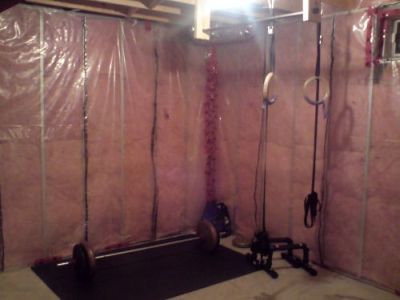
We’ve been in the house for about two weeks now.  One of my first priorities was to setup a small area in the unfinished basement to workout.

As I’ve mentioned before, I don’t have much equipment.  I’m a firm believer that all anyone really needs is a bar, some weight and some space.  That said, I have a pair of rings as well that I abuse on a regular basis.  The grip tape on them has been worn out several times now.

One thing that’s been missing from “my gym” has been a pullup bar.  At my old house, there weren’t many options for putting one up.  I toyed with the idea of a bar that works in a door frame, but from what I’ve heard and read, you can’t kip with those things.  I like to kip.  For me, a pullup bar has to be rock solid.  Also, given my frugal nature, a bar has to be cheap as well.

Fortunately my new house is right around the corner (literally) from a Home Depot.  The other day I picked up the following:

  • 2 2×6 cut 18″
  • 1 48″ steel pipe 3/4″ diameter
  • 6 5/16″ carriage bolts, nuts and washers

That’s all it took for a sweet, totally solid pullup bar that I can kip on till my heart’s content.  I drilled out a 3/4 inch hole in each 2×6 and used the carriage bolts to attach to two joists in the basement.

I also purchsed some $25 rubber matting from Walmart to keep my feet from freezing off in the basement when barefoot and to buffer the sound of the weight hitting the floor.

My new pullup bar.  Totally solid.


Fat Head Documentary - Debunking the Low-Fat Diet


We saw Spurlock’s “Super Size Me” taking on the fast food industry by having the him gorge himself on McDonald’s at least 3 times per day, claiming that if he kept going at his pace, the high fat content would surely kill him. For years, the public has been made to believe that eating fat makes us fat and causes health problems. Now a new documentary, “Fat Head“, by Tom Naughton, is coming out to attempt to use Spurlock’s documentary techniques against him and the rest of the anti-fat community.
Here’s a trailer:


Where Has All the Low Carb Food Gone?


While diets like Atkins or Zone or South Beach are labeled as “fad diets” by many people, truth be told, many people enjoy great success at not only losing weight by following carbohydrate restricted diets, but vast empirical evidence suggests that going low carb can lead to better overall health. However, Canadians looking to live the low carb lifestyle are faced with a dilemma.

This weekend is my wife’s birthday. We’re having some family over for dinner to celebrate and I thought I’d take the opportunity to bake a big batch of low carb savory macaroni and cheese. The catch, of course, was that the recipe called for low carb elbow macaroni and bread crumbs. Easy enough, I thought. But after scowering half a dozen grocery stores, I was empty handed.

Faced with this problem, I looked to the Internet (as always). It turns out that I wasn’t the only one looking for some low carb pasta to no avail. Dreamfields seems to be the popular low carb pasta brand in the US, but while once sold in Canada, it is no more. Turns out that you’d be hard pressed to find any low carb products in Canadian grocery stores.

In 2003, the Canadian Food Inspection Agency made amendments to the Food and Drug Regulations, setting requirements for nutritional content and diet related health claims on food labels. Specifically, restrictions were put in place on labeling products as low carb or variants thereof. Just as grocery store shelves began getting stocked full of low carb food items, companies began pulling the items out of the Canadian market. The obvious reason - if you can’t advertise the benefits of one food item over another, then why bother even making it available in the first place.

So what are we to do? Fortunately there are options. The Low Carb Grocery, based in Toronto, has a fairly inexpensive mail order operation going on. And they have it all, including Dreamfields pasta. But if you’re looking to cook something soon and don’t have the luxury of being able to wait for your food to show up in the mailbox, you’re forced to really look hard to find something that will meet your low carb needs.

I finally settled on Catelli’s Smart elbow pasta which is a white pasta that supposedly tastes unlike the whole wheat kind but has all the fibre benefits making it the lowest net-carb white pasta that I could find. I also found a loaf of Dempster’s whole wheat bread that contains only 7 grams of carbs per slice. In fact, Dempsters was daring enough to advertise this on their packaging despite the regulations (in 2008, further amendments were made to the legislation such that companies are now allowed to advertise the carb content on food labels, so long as there are no other words involved).

But here is the crazy thing about all these low carb label restrictions. They exist, apparently, because of the lack of scientific evidence that low carb is a healthy lifestyle. Fine - despite the fact that I (and many, many others) think opposite, a fair argument can be made of that. But what about the thousands of labeled low fat or prebiotic items for sale? Not only does scientific evidence fail to find these things healthy, empirical evidence is turning up suggesting that low fat diets are actually bad for your health. So why isn’t labelling things as low fat equally restricted??

At the end of the day, it seems that government bodies sometimes feel it necessary to restrict society from making mistakes. Unfortunately they’re just like you and me and many times not only do their priorities get screwed up, they just get things plain wrong. However, with the low carb thing, enough empirical evidence does exist today that I think some further amendments should be made to the legislation to allow a reasonable use labeling to suggest low carb so that companies can begin selling their low carb items in Canada again outside of the rare specialty shops.


Interview with Gary Taubes on Good Calorie, Bad Calories


Last year, CBC Radio show Quirks and Quarks interviewed Gary Taubes, the controversial scientific writer and author of Good Calories, Bad Calories: Challenging the Conventional Wisdom on Diet, Weight Control and Disease. Here is said interview:


Taubes discusses the hypothesis of how the unjustified adoptation of low fat dieting throughout the medical world has caused the obesity pandemics that we see today. Very interesting and definitely worth a listen.


Food, food, food


Food - breatharians may claim it isn’t needed, but for the overwhelming majority of us, there’s no denying that food is a critical part of life. Unfortunately, what we should eat to be healthy is a seemingly constant debate resulting in ever changing diet books and programs.

Trying to dissect the volumes of volumes of information is incredibly difficult for the average person. What makes it even more difficult for us is that none of the information is consistent and it seems that even the experts get everything wrong. If they can’t figure out what we should eat, then what’s a guy looking for a healthy diet supposed to do?

The answer is research, and lots of it. Over the last little while I’ve been reading all that I can on nutrition, attempting to not get stuck in the fads and one solution fits all kind of mentality. It’s difficult trying to make heads or tails of nutrition, but I’ve come across some great stuff that I thought I’d share.

While there are more and more “fad” diets coming out with books and all sorts of highly marketed material aimed primarily at sucking dieters dry of their hard earned cash, many of the more recent diet programs are incredibly closely related and for the most part, they follow similar principles. Atkins, Zone, Paleo, Glucose Revolution, South Beach and countless more diets all basically revolve around the idea of low carbs. While some of them such as Zone and South Beach mask the low carb idea around insulin or glycemic indecies, ultimately they paint refined, high density carbs as evil and prescribe significant amounts of protein and fat as a crucial part of the diet. Read on…


Outback’s Aussie - the Worst Food in America


I just had to scan this in and post it. Again - from this month’s issue of Men’s Health. Reminds me of Taco Bell’s Cheesy Fries and my daily intake of calories during University (mmmm chili cheese fries). Looks awesome. Tastes great. But nearly 3000 calories? Geesh!

img019_thumb.jpg


Reduce Food Cravings by Chewing Gum


gumchewing.jpgSometimes you feel hungry when you don’t really need to eat. Typically in these moments are in between meals and usually less healthy choices are made - we reach for the bag of chips or chocolate bars - yes, the joys of snack time.

But what if there was a simple way to control those cravings. A recent study from Glasgow Caledonian University in Scotland found that chewing gum before snacking could help reduce hunger and promote a sense of fullness. The study showed that the average caloric intake from snacking was reduced by 25 calories among dieters and over 35 calories among non-dieters. Although seemingly insignificant, over the long term these calories add up. The study participants also reported that gum chewing helped improve mood and contentment.

So grab a stick of juicy fruit (sugar free) the taste is gonna move you (less towards the fridge door). I know… terrible joke attempt.


Calories and Sugar in Top 20 Popular Drinks


oj.jpgWhen you’re thirsty, what do you grab from the fridge? We all know that water is best as far as calories go. It’s also easy and cheaply available. But unfortunately it is also bland and quite boring. Lately I’ve been kicking it up a notch by including a bottle or two of carbonated water in the fridge. I find it adds a little something extra to the otherwise ho-hum beverage. Sometimes, however, I’ll go for a beer or juice. But how many extra calories would I be consuming by making the alternate decision?

Here’s a top 20 list of some of the most popular drinks and their associated calorie and sugar counts. A couple pints of Guinness and I’d be at my 100% daily caloric intake :)

Item Calories Sugar (g)
Guinness beer (1 pint) 210 17
Coca-Cola Classic (1 can) 140 39
Fruit punch - concentrate (1 glass) 120 27
Apple juice (1 cup) 117 29
Hot chocolate (1 cup) 112 20.8
Orange juice (1 cup) 112 21
Dr. Pepper (1 can) 110 30
Heineken beer (1 bottle) 110 7.5
Bud Light beer (1 bottle) 110 6.6
Milk 1% (1 cup) 102 12.7
Champagne (1 glass) 91 1.2
Tonic water (1 can) 90 23
Coffee - 1 cream, 1 sugar (10 oz) 75 9
Red wine (1 glass) 74 1.8
White wine (1 glass) 70 0.8
Lipton iced tea (1 cup) 70 20
Martini (dry) 62 1.5
Club soda 0 0
Tea - black (1 cup) 0 0
Water (1 cup) 0 0


Staying Fit While On Business Trips


I recently had to make a 3 day trip down to Sunnyvale California for work. It was a pretty good trip, as far as business goes (although the weather was oddly cooler than here at home in Canada).

Heading out of town for any length of time breaks up the normal routine. Sleeping, eating and exercising are all completely disturbed by meetings, work and jet lag. But with some effort, the potential damage to these three essential pieces of the fitness pie can minimized.

As I’ve mentioned in many previous posts, sleep is very important, not only for staying healthy and keeping your brain active, but for building muscle and weight loss.

Flying outside of your timezone will modify your sleep cycles enough to totally cause a run down. I find that flying East and gaining time is the most difficult. Regardless, catching some Z’s on the plane will help. Especially if you’re flying an all nighter. But there’s nothing worse than trying to sleep on the plane.

Bring on the plane:

  • a neck support
  • some ear plugs
  • a blind fold

as soon as the first meal and movie is finished, plug your ears, support your neck, blind yourself and wrap up in a blanket. This will help get some necessary shut eye.

When you get to your hotel and your first night arrives, try to push yourself through to your normal sleep time. Otherwise, you might find yourself going to bed super early and waking up at 4am.

When it comes to eating while away, restaurants and fast food are unfortunately on the meal plan. But even when faced with double cheeseburgers and heaping piles of mashed potatoes, there are always ways of maintaining a healthy diet.

Always try to keep the Zone mentality in mind when getting a meal. Make sure to balance the protein to carb ratio, 30:40.

If you’re getting breakfast in the hotel restaurant, bacon, eggs and some fresh fruit would be ideal. Hold off on the potatoes and toast. Lunch or dinner requires something quick? Go ahead and burger it up, but skip the fries and toss the top of the bun. If a salad is offered as a side, always go that route instead of something fried.

Dinner portions at restaurants are generally huge (especially when paid for by the company) so know your limit. Just because there’s food on the plate doesn’t mean you need to eat it all. Try to skip out on the alcohol. It may be difficult, but at least stay away from the beer. Beer may taste great but we all know what it means to the bellies.

Working out, on the other hand, may be easier to accomplish during a business trip than while at home. The distractions of family life are not present and most hotels have at least some form of exercise room available.

Check when you arrive to see what time the hotel gym opens at. If you’re flying from New York to Santa Clara, you will probably be up before the sun rises so take advantage of the early morning and charge yourself up with a workout.

Most likely, however, the hotel’s exercise room will contain mostly treadmills and possibly one or two universal machines. You’ll be lucky if there are dumbbells or any other equipment. Make the most of what is available and improvise. Remember that no matter what kind of lack of equipment you’re faced with, you will always have pushups, situps, leg raises, squats and dips.

While away on business, you will be faced with all sorts of obstacles to your normal routine. The key is to try and keep up with your daily activity and manage to eat healthy.

Don’t give up and pretend that you will just continue with your routine when you get back. More likely than not it won’t happen. Once you get distracted from your workout schedule and eating plan, it is really difficult to get back on top of it.


Top 10 Snacks


Let’s face it. We all need the occasional snack. But what to snack on? For fit sake, here’s a list of the top 10 snacks to keep you going when the going gets tough.

  1. Almonds. High in monounsaturated fats - the good kind. A handful of almonds a day has also been shown to lower cholesterol and keep off the lbs.
  2. Berries. Fresh berries are nature’s antioxidants. Low in calories, they’re a good snack as well.
  3. Multigrain baked nacho chips and guacomole. Again - more of the good fats. Plus, avocado is super high in protein.
  4. Pickles. Low in calories. Super low in calories. Some jars will even go as far as saying 0 calories. However, watch for the high sodium. Be choosy and look for a jar of low sodium pickles.
  5. Fat free yogurt. I know a girl who says that men eating yogurt out of the little containers is unmanly. She’s probably right, but yogurt is so damn good, it’s worth it to look like a sissy boy sometimes. High in protein and vitamins, fat free yogurt is a great snack. Probiotic yogurts are even better, helping the digestive system.
  6. Beef jerky. It looks disgusting, but smells great and tastes even better. Super low in calories. Super high in protein. Again, however, just like the pickles, watch out for the salt.
  7. An apple. Apples are simple. You can pick one up and eat it without any preparation. Apples contain no cholesterol, no fat and are fairly low in calories.
  8. A protein shake. No, don’t be fooled by the smoothies sold at the coffee pub - they’re generally loaded with calories. I’m talking about your own protein powder and water\milk shakes. They’ll kill the hunger pangs while giving your muscles the protein boost they deserve.
  9. Turkey bacon. Much lower in fat than the oinking alternative, turkey bacon can be a decent high protein snack. Cook up a bunch of strips on the weekend and keep them in some tupperware in the fridge. Need a snack? Just grab a couple strips - it tastes great cold.
  10. Carrots. High in dietary fiber, vitamin A and other nutrients, carrots are easy to pack in a ziplock for the road or to munch on while watching the tube.


Why You Should Drink More Water


Sure, you’ve no doubt heard that you should be drinking more water. But why? Here’s a list of 7 reasons.

  • Water contains no calories. Unlike fruit juices and sugary drinks, water will hydrate you and quench your thirst while not affecting glucose or insulin levels.
  • Our bodies are more than half water. It is essential that we get enough water in our system on a daily basis to maintain ourselves.
  • Drinking enough water throughout the day will keep your organs, like your liver and kidneys healthy and working properly.
  • Drinking water is virtually free. True, many people these days purchase bottled water, but the difference between that water and the water coming out of your tap is probably minimal. Fortunately water is one of the few things left on this planet that we can still get for free (sort of).
  • Diet sodas have artificial sweeteners and other chemicals that could potentially pose health issues (although there is currently no direct evidence of this). At the very least, artificially sweetened drinks keep your “sweet tooth” wanting more sweet stuff which might come in the form of a candy bar. Water is plain tasting and could help aleviate your “need” for sweets.
  • No stains. An often overlooked benefit of drinking water is that if it spills, cleanup is simple and there shouldn’t be any worry about stains on your new shirt.
  • Ever hear of the saying, “8 glasses of water a day will keep the dentist away?” Well, neither have I. I just made it up. However, it could be somewhat true. Less sugar intake from sugary pops and fruit juices would definitely be a good thing for cavity prevention.