Why is it so difficult to maintain a healthy diet, when it’s easier to cook a healthy meal than it is to cook a high fat\carb meal?
A chicken breast and a side of cooked frozen veggies takes practically no effort. Even throwing a frozen pizza in the oven takes as much effort (take it out of the box and struggle with the cellophane wrapper). Yet, I guess on those lazy days, it just seems more appealing to eat a cheesy pizza than some bland, semi-dry chicken and veggies.
My suggestion, however, is to cook a bunch of stuff up on Sunday - several chicken breasts, some turkey bacon or maybe even a pot of turkey chili. Throw some in the fridge and some in the freezer. Make your meals microwavable and you’re gold.
Frozen veggies go a long way too - throw a couple cups of frozen green beens and a couple cups of frozen broccoli in a tupper-ware container with a drizzle of olive oil and balsamic vinegar. Add a couple slices of cut-up deli meat and bring that to work for lunch. Throw it in the micro for a minute (don’t make it too hot - it’ll stink the office up) when you’re ready to eat and give it a stir. Tastes pretty good, takes no time and is incredibly healthy. Lots of fiber, some protein and the good kind of fat and carbs. Gold.
I belong to a nice gym. It just went through a good renovation and acquired some more equipment (having another couple pullup bars is nice). It’s not a huge franchise like Golds but it tries to cater to a similar crowd with the machines and whatnot. Nope, it’s nothing special, but I like it and besides, it’s down the street.
Regardless of the proximity of the gym to my home, however, there are those nights where I just don’t get home from work in time to get there for a good workout before they close. Or maybe I’m just short on time one day and can only get a half an hour in. On these days, I’m very glad that besides my gym membership, I also have a great home gym.
At my home gym, I can do all sorts of exercises - squats, cleans, deadlifts, presses, jerks, snatches, curls, hit the core, the shoulders, the legs, the arms and the back all in the comfort of my own home. And how much did this home gym cost? Nothing. Wha?!?! Yep, that’s right.
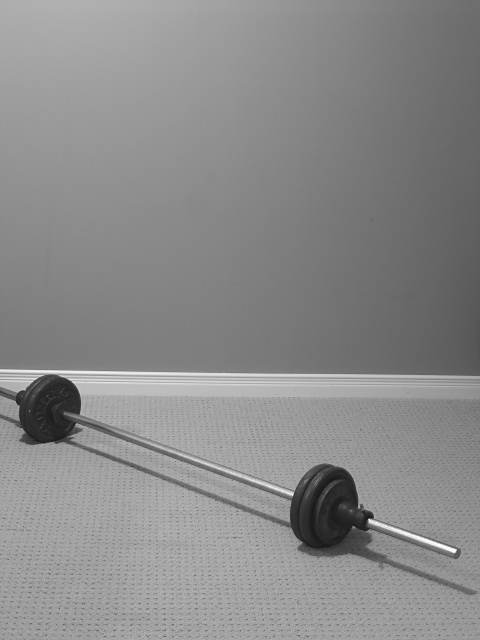
You see, all my gym consists of is a 25lb barbell and about 50 lb’s in plates. All it cost me was a trip down to my parents’ basement where I knew my Dad had a few weights sitting around gathering dust since his days when he was my age. Sure I’m not going to be pressing my max or deadlifting hundreds of pounds, but even with this measly setup, I can whip off a few sets of high intensity, high rep sets of several full body exercises.
There is no need to have the latest bowflex machine for $20 per month for the next 50 years. No real need to get an elyptical or high cost treadmill. All anyone really needs is some inexpensive weights (or possibly free for the lucky ones), a bit of empty space in the house (or the garage, or outside) and maybe a good outdoor route to occasionally run.
A good spot to find cheap weights are garage sales. Typically a good hunt early on a Summer Saturday morning will reveal some weightlifting equipment that was laying around in someone’s basement. Salvation Army and other second hand stores will also occasionally carry exercise equipment.
Going for a 5 or 10 km run is a fantastic aerobic exercise that will burn lots of calories. However, the normal run is generally a moderate intensity exercise.
Long bouts of moderate intensity exercise may actually preferentially burn more muscle tissue than one would like [1]. The goal, after all, is usually to burn calories from carbohydrate storage and maintain muscle.
Some studies have found that brief intervals of high intensity training are more effective at maintaining muscle and building their capacity for lactic acid oxidation [2].
Lactic acid builds up as muscles undergo intense strain. You may recognize this as the burning sensation you might sometimes feel as you’re trying to lift that last rep or trying to sprint the last 100m of a good jog. During the recovery from bout of the high intensity, lactic acid is broken down. This process uses energy from carbohydrate storage or fat [3]. Translation - interval training may be better than a moderate intensity run for losing fat and getting lean.
So next time you’re heading out for your weekly (or monthly or whenever you can get yourself off the couch) run, perhaps head down to the track instead and run 5 or 6 400m sprints, each followed by 2 minutes of rest. It may take less time than a 10k jog, but it may be just as effective.
Of course, all food has calories. Some vegetables have very little, true, but they’re still there. Wouldn’t it be nice, however, if there existed a food that by eating it, calories actually came off? But if all food contains calories, how on Earth is it possible to get a decrease in daily caloric intake simply by consumption?
There is some controversy about this, but some research indicates that there is a small list of foods that require more energy from the body to digest than the foods themselves contain, resulting in a net negative caloric effect. Celery is one example of a food that may require more energy to absorb the nutrients than the energy contained within. This may be because the energy in celery is sealed, which requires the digestive system to work harder to obtain the energy. However, other vegetables and fruits may also have the same or similar effect. Some of these “negative calorie” foods include asparagus, cabbage, cucumber, tomato, melon, rhubarb and lettuce. As you can see, regardless if these foods actually do have a negative caloric effect, this food list contains some extremely healthy items that would definitely already be part of a good diet or weight loss plan.
The moral of the story is that negative calories or not, eat lots of veggies and fruit and you are well on your way to shedding unwanted weight.
For more information on negative calories, check out healthrecipes.com.
So what is this Zone thing? Is it another fad diet to drop into the South Beach or Atkins bucket? For ages, people have searched far and wide for the secret diet that will shed their pounds and rid themselves of evil fat. Unfortunately, as many professionals would tell them, there is no secret. To get desired results requires work, motivation and to some extent, will power - will power to not cave into cravings. This is one thing that all of these diets share - the necessity to have the will power to not cave for the sweets and high carb foods. There is a major difference with the Zone diet though. Instead of forgoing carbs and relying on protein or fat for nutrients and calories, the Zone diet just says that for every gram of carbs eaten, make sure that protein is consumed in a specific amount to make the ratio of carbs to protein always 40-30. And instead of telling readers what to eat and what to watch out for, in his book, “A Week in the Zone”, Dr. Sears (the creator of the Zone diet) instructs the reader about how the relationship of carbohydrates, protein and fats plays an important part in the regulation of insulin and ultimately how the pounds pile up. Dr. Sears says that keeping an insulin balance is the key to not only shedding the weight, but to maintaining a healthy body. He cites many advantages to the Zone diet including weight loss, disease prevention, graceful aging, blood sugar control to name a few.
“A Week in the Zone” also gives the reader sample eating plans for a full week, for both males and females. Included with these plans are the grocery shopping essentials and tips on how to shop. Other recipes are also included so that if the reader wishes to continue the Zone beyond a week, the meals won’t get boring. Beyond the eating information, in “A Week in the Zone”, Dr. Sears also defines what he believes are the important elements of a healthy lifestyle. A healthy lifestyle (and an essential part of losing and maintaining weight) includes exercise and Dr. Sears also presents basic exercising techniques to use in conjunction with his diet. Besides the exercise aspect, meditation is also a part of his plan and is also briefly discussed.
Overall, “A Week in the Zone” is a fairly good book that has actually helped me choose what and when I eat and if nothing else, has truly made a noticeable difference in my blood sugar levels. It’s a short book, but it lays out the basics for a healthy lifestyle in which a good diet is the key to success.
Jonathon Morgan posts regularly about his running endeavors over at thatsfit.com. I guess he writes a sort of blog column called “Jogging for Normal People“. The blog entries are great. I always find that I can relate to his comments and they’re always well written and funny. My favourite thus far has to be “Admitting the Truth“. Great stuff.
A hint of sweetness, a little bit of chewiness with a side of crunch. That’s how I’d describe the Almond and lately it’s been a staple food for me, particularly for helping to curb those spontaneous snack attacks.
Fortunately, Almonds are an incredibly healthy nut. Not only are almonds low in carbs, high in protein, fiber and essential vitamins and nutrients, a handful of almonds a day has been shown to lower LDL cholesterol (the bad kind) while not contributing at all to body weight or glucose levels (*). In fact, studies in which participants were put on diets with moderate fat from almonds show that the group eating the almonds had the greatest weight\BMI reduction (*).
I was just searching around the net and I cam across the “Bodybuilding.com Personal Trainer Program“. This is a free site that contains a great deal of information about setting up a program to help you meet your fitness goals, whether building muscle, losing weight, sexual health, aging gracefully or just generaly staying fit. It can be read in HTML form or downloaded as a PDF or MS Word document.
The program involves the same or similar diet and exercise routines that can be found in a bazillion other places, but bodybuilding.com has presented the info here in a very easy to read way and combines the whole kitten caboodle into a single concise source. The guide also includes handy calculators and videos to help you modify various elements to suite yourself. There are also great links to other sites and pages with related information that isn’t covered in the guide itself.
For individuals who are looking for free assistance to help them get to where they want to be, I definitely recommend taking a look. Especially if you’re looking to develop a good program and you’re just starting out. To get to the site, just follow this link.
If you’re looking for a good cardio workout, choose running over walking and rowing over either, but if you’re looking for a good cardio workout and you’re short on time, jumping rope can be a super good alternative. An intense 15 minute rope jumping session will likely do for you what 30 minutes of running can do. Plus, it can be fun and challenging. Try double unders, crossing your arms or some fancy footwork. Here are a couple of videos for some inspiration:
I said it in my last post and I’ll say it again. The squat is not to be underestimated as an exercise. A good variation of the squat, sometimes called the pistol, involves working one leg at a time - ie, a one legged squat. In their December 2006 issue, Men’s Health had this to say about it:
“The single-leg squat touchdown is one of the most natural athletic movments: You bend at the knees while balancing on one leg. So even if you’ve never done the exercise, you’ll find youself in similar positions in sports. As a timed test, the move measures your ability to stay strongw while keeping a stable base, an important factor in almost any activity, and key to building muscle.”
“Balance on your right leg with your knees slightly bent. Start your stopwatch. Slowly bend you knee to lower your body toward the floor while reaching toward the outside of your right foot with your left hand. Push through your heel and squeeze your glutes to return to the starting position, then repeat as many times as you can. Stop the clock when you lose balance and have to stand on both feet. Then restart the clock and repeat on your left leg.”
If there is an exercise that could help with movements the human body goes through day in and day out, it’s the squat. Whether lifting something heavy, standing up from a chair, or even simply walking, elements of the squat are apparent.
With the bending of the knees and often heavy lifting involved during a squat, it is thought by many to be an unsafe exercise, specifically for the knees. On the contrary, it has been found that the squat is, in fact, a deterrent for future injuries. Regardless, with the amount of lower body muscles that the squat targets (particularly those problem areas ladies), makes it an ideal exercise that should be included in your exercise repitoire. Most importantly, this exercise can be done without any weights at all and still be incredibly effective. Crossfit includes the air squat in many of its workouts and as part of its official warmup.
In order to perform the air squat, stand with your feet just past shoulder width apart. Keep your head above your knees and bend your knees, moving your butt down and out past your ankles. Your arm position isn’t incredibly relevant, but some people find it easier to move the arms up as you squat. However, you may find that holding your arms up, straight over your head, will give you better form when squatting. Once down begin to raise back to the standing position. You should try to get your butt down to just below your knees. If that’s too far just go as far down as you can.
The Crossfit website has a great video demonstration of the correct air squat form here.
Here’s a sample squat routine that will surely make you feel the burn:
Start off with 10 full deep air squats, then hold in a squatting position with your knees bent and your upper legs perpendicular to your lower legs. Hold this position for a count of 10. Then perform 9 full deep air squats and then again, hold the squatting position for 10 seconds. Repeat for 8 and so on, working your way down to 1, holding for 10 seconds between each set. No weights involved and it shouldn’t take much time at all, yet your legs will feel like jelly and you will certainly be completely out of breath. For these reasons, the squat is a great exercise.
We’ve all been there, walking down the sidewalk, seeing a nice curb and spontaneously deciding to walk on that instead – finding our balance, making our way to the end without fault. As a child, jumping and running on things that were never meant for such abuse was practically a day to day ritual done perhaps simply for the enjoyment of the challenge to conquer the urban landscape. Today, more and more individuals are taking this childhood pleasure to the next level in the form of what is known as parkour or free running.
Parkour is a sport where city streets become the runner’s jungle gym and the main objective is to overcome the urban architecture as quickly as possible. Picture yourself going for your morning run and coming across a 6 foot brick wall that you would normally just run around. However, this time you go over it. That’s the idea. Brick walls, fences, large staircases, even buildings and the gaps between them – to a traceur, are all things to overcome, not get around.
The sport began in the Parisian suburbs and is quickly becoming recognized and practiced globally. Perhaps akin to skateboarding’s rise in popularity after only a handful of individuals began “surfing” the streets in Santa Monica. The popularity of parkour is becoming evident in pop culture and media. The recent (2006) James Bond film, Casino Royale, featured an amazing feat of free running (a variant of Parkour) skills as Daniel Craig (007) chased Sebastien Foucan, the creator of free running, through a construction site, performing intricate free-running moves. Sebastien Foucan was also one of the free runners in Jump London, a BBC documentary showcasing the sport as he and his crew took on many of the great London monuments and buildings.
Besides being interesting to watch, elements of parkour and free running can be seen as great exercises, some of which are part of well established training programs. Weather for scaling a wall or jumping from one building to the next, parkour necessitates exceptional upper and lower body strength. Pull-ups, dips, squats, handstands, and jumping are great conditioning exercises that would probably be involved in parkour training. Why not bring these into your own routine. Change it up a bit. That pull-up bar at your gym probably has dust on it. Give it a go. Find an empty wall and try to kick up a handstand. No gym, no problem – for dips, just use a couple of chairs as dip bars and let your legs sit on the floor in front of you, or raise them on another chair. Air squats, handstands and jumping don’t even require any equipment and 5 back to back sets of 10 reps of each exercise provides a great full body workout.
Looking up parkour in youtube provides endless movies of parkour acrobatics. Here’s just one of many for a bit of inspiration. It’s of David Belle, the founder of parkour, showing off:
Update: Jump Britain, the “sequel” to Jump London can be found on Google Video, in its entirety, here.
Update #2: The New Yorker recently published an article on Parkour, titled “No Obstacles”. Read it here.