TheFitBlog.net Upgrade!


Welcome to the newly designed version of www.thefitblog.net!  Gone are the days of the default blue wordpress theme and here to stay is the minimalist custom job of yours truly.  Yes, it’s simple, but it works nicely and I like it :)  I also used the opportunity to install a much needed upgrade to wordpress.


May 2008 Muscle Ups and Handstands


Progression on my muscle-ups and handstands is coming along. I’ve got about 5 consecutive muscle-ups now and I’m getting more and more comfortable going into a handstand and balancing (although I still can’t get my legs straight). I threw together a small video to show the to-date progress:


music in the video is by Kill Hannah – a Chicago band that’s somehow managed to stay out of the spotlight for years.


The Sinclair Total Calculator


I recently came across the Sinclair total from Crossfit Mobile’s website – they’re hosting a weight lifting comp in June. The Sinclair Total is a number that represents one’s Olympic total (total weight lifted for the snatch and clean and jerk, combined) in a calculated form that can be compared easily to others’ totals, taking into account the lifers’ weight differences.

Generally the heavier one’s body weight, the heavier they can lift. Therefore, as it would be unfair to pit a 400lb behemoth against a scrawny 125lber, weight lifting meets usually have multiple weight classes. In order to correctly compare the ratio of weight lifted to lifters’ weights across all classes, and thus be able to more appropriately rank all lifters, the International Weightlifting Organization uses the Sinclair Total, which is the true total multiplied by a coefficient for a given bodyweight.

After learning about the Sinclair Total, I quickly went to the calculator to attempt to calculate my own SC. It’s a fairly straight forward calculation, but may require some scientific calculator wizzardry so I thought it was appropriate to create a little Sinclair Total calculator in javascript. Behold…


Weight Training – Do It


Great article here on the New York Times website. It discusses how weight training is not only a vital part of a balanced fitness routine, but is vital for long term health.

The main point that Dr. Paul Thompson suggests is how unstimulated muscles eventually atrophy and is the primary reason why elderly individuals tend to fall more or have difficulty walking or taking stairs. Lifting weight isn’t about bulking up or toning – it’s about keeping the muscles healthy. The article also captures arguments from other specialists, including professor William Kraemer of the University of Conneticut who reiterates the falicy of the argument of why many women avoid weight training – the fear of “bulking up”. “this fear is unfounded, Dr. Kraemer and others say. Acquiring muscle mass requires testosterone levels that women don’t have. Instead, the toning that many women say they want comes from lifting heavy weights.”


The Most Wicked Muscle-Up Ever


Check out this muscle-up.  The gymnast is Andreas Aguilar at the 1991 World Professional Gymnastics Championships.  Andreas makes it look so smooth and easy, it’s truly unreal.  The rest of his routine is also great, including the unusual dismount, but a muscle-up like the one at the beginning of the video would take an incredible amount of strength.  I can’t even imagine how much training would be needed to build up the strength to pull so smoothly.  The cheering crowd in the background seems to agree.


Inspiring Image


Crossfit Going Mainstream?


More and more evidence is showing face indicating that crossfit is going mainstream. Here are a few links to some recent articles appearing in some popular health and fitness magazines…

crossfit_fitnessrxformen_march2008.jpgcrossfit_mensjournal_may2008.jpgcrossfit_muscleandfitness_may2008.jpg


Rock Climbing – a King of Kings for a Workout


There’s something inately pleasing about reaching for another grip while dangling 20 feet off the ground percariously perched on maybe a few inches of foot holds.  Those few seconds of barely hanging on, followed by a satisfying and reassuring hand placement and attaining another foot in an ascent – albeit an easy 5.5 grade climbing wall.  No, it doesn’t get much easier than that, as far as climbing goes, but getting to the top is a great feeling regardless.

Over the weekend, I took my first steps into the world of rock climbing.  It has always been something that thought I was somewhat interested in, but for one reason or other I never got around to doing.  After only a couple of hours of working the walls, however, it became incredibly apparent that I was far more interested in it than I ever really knew.  Afterwards, I couldn’t help but conetmplate why I had never gotten into rock climbing before and why it wasn’t until the end of my 30th year that I decided to give it a shot.

On Saturday, Sonya and I showed up at the Guelph Grotto to take their appropriately named “Show me the Ropes” course – a two hour training session with a high school aged climbing instructor.  The instructor showed us how to tie the necessary knots and gave us a quick lesson on how to belay (controlling the climber’s rope) then it was off to some of the easier routes on a couple of the walls.

In short, we had a great time.  Rock climbing is loads of fun.  Beyond that, it is a serious total body workout.  After only a few times up the walls, my forearms and hands were toast and the next day I was sore from top to bottom.  I had no idea that my legs would get such a good workout as well.  Beyond the physical workout, a major aspect of climbing that I overlooked is the mental challenge – trying to figure out which foot to put where and how to maneuver from one hold to another.  Overall, climbing is a great way to get a complete workout and have a really good time.

We really enjoyed it and can’t wait to go back and work on the lines that we had trouble with this time out.


The Handstand – It’s All in the Wrists


I’ve been working on my hand balancing for while now. It’s better – a little bit anyway. Unfortunately I think one of the missing gaps at the moment is weak wrists.

The wrists unfortunately take the majority of the burden of keeping the body upright. If you begin toppling over knees first, there is only so much you can do, but if you fall backwards (towards the back of your head), you can put pressure on your fingers to stop yourself from going over… as much as you can anyway. Thi causes some extreme work for the wrists. Wrist flexibility and strength are key elements to the handstand.
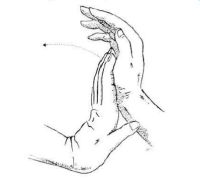
wrist_flexibility1.jpg Training for wrist flexibility is fairly straight forward. The York Hand balancing course (circa 1950) shows the following diagram for working on this diagram for some simple wrist flexibility work. Hold the fingertips and pull the wrists backwards. Easy peasy. Fortunately you can do this whenever, without any special equipment (or any particular situation).

What about working on wrist strength? Squeezing the hand shut is one method for strengthening the wrists. Stress balls are an inexpensive tool that can be brought to work or used in front of the TV without much focus. Winding up a towel and squeezing that is even less expensive. Alternatively, grip strength equipment can be purchased at most fitness stores. Are they worth it? IMHO, probably not.

Another somewhat inexpensive tool for working on wrist strength can be built fairly easily. It consists of a simple wooden dowel, some rope and a weight. I fashioned one of these this afternoon in less than 15 minutes.

forearm_strength.jpgTake a 1 – 2 inch thick wooden dowel, and drill a hole through the middle. Sew a 4 foot rope through it and tie a knot at the end of the rope so that the rope can’t fit back through the hole. Then tie up a weight (or two) at the other end of the rope. To use this tool, simply wind up the weight and wind it back down. Working on this magnificently simple piece of equipment a few times a week will give you some serious forearms.



Random Handstand – Crissy Field in San Francisco


Sonya recently had a conference in San Francisco so I decided to tag along with her to do some site seeing. What a great city. So much going on. Down by Crissy Field, near Golden Gate Bridge, the paths and beach were filled with people running, biking and playing. It’s just such a lively environment. Anyway, I decided to join in on the liveliness with another random handstand shot with the bridge in the background.

Random Handstand - Crissy Field


Deadlifts – Not Necessarily a Spectator Sport for the Queasy


I did deadlifts last night. Worked on my technique more than anything, but pushing my max lift a little higher. My form on the way up is fine, but on the way down I can’t help but lose to a rounding of the shoulders. While on lighter loads there’s no problem, once I hit around 275#, my shoulders start rounding on the way down.

That’s one thing, but once I hit around 300#, after I let the weight down, I get seriously woozy and need to take some deep breaths and put my head down. The thing about deadlifts is that they seriously tax the CNS (central nervous system – those billions of neurons from the brain through the spinal chord) from the heavy vertical weight on the spine. Plus the heavier you go, the higher your blood pressure goes. In fact, although not very common, it isn’t unheard of for one’s body to cope with the high pressure by blowing out a blood vessel, causing a bloody nose. Don’t believe me? Check this video out (I don’t know who he is, but it’s obvious he’s a strong dude – in this clip, he’s lifting 765lbs!) :


Now That’s a Little More Like It


Now that’s a little more like it.  Today I managed a 265# squat.  I think I had a little more in me, but I didn’t want to push it too much.  So no more benching more than I can squat – that was ridiculous ;)


My Max Bench Press and my Not so Max Squat


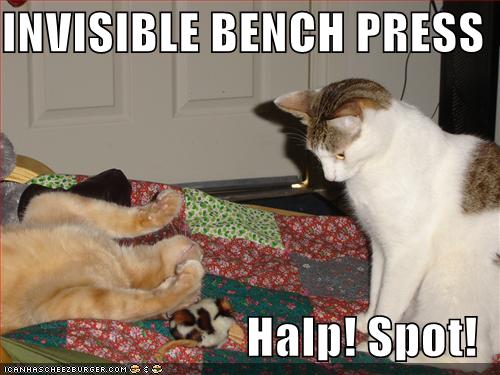
invisible bench press
see more crazy cat pics
Last night the local crossfit WOD was 3-3-3-3-3-3-3 bench presses, working our way up to our max.

The good news is that I managed a max bench of 215lbs! that’s over 40lbs beyond body weight. The bad news is… and I’m extremely ashamed to say this, but during our last crossfit total, I maxed out at a 205lb back squat. Huh? Yep – that’s right, my max squat was 205lbs and my max bench press was 215lbs. In my eyes there is something seriously wrong with this picture.

I have a feeling (and I hope) that my max squat wasn’t really my max – it was just hovering around where I though my max would be relative to the other guys doing the total with me. On my next total, I think that I should be able to do at least a 250lb back squat as a 1 rep max – hopefully even beyond that. Grrrrr…. It kinda makes me a little PO’d that during the total I didn’t try harder. Grrrr….


Where Has All the Low Carb Food Gone?


While diets like Atkins or Zone or South Beach are labeled as “fad diets” by many people, truth be told, many people enjoy great success at not only losing weight by following carbohydrate restricted diets, but vast empirical evidence suggests that going low carb can lead to better overall health. However, Canadians looking to live the low carb lifestyle are faced with a dilemma.

This weekend is my wife’s birthday. We’re having some family over for dinner to celebrate and I thought I’d take the opportunity to bake a big batch of low carb savory macaroni and cheese. The catch, of course, was that the recipe called for low carb elbow macaroni and bread crumbs. Easy enough, I thought. But after scowering half a dozen grocery stores, I was empty handed.

Faced with this problem, I looked to the Internet (as always). It turns out that I wasn’t the only one looking for some low carb pasta to no avail. Dreamfields seems to be the popular low carb pasta brand in the US, but while once sold in Canada, it is no more. Turns out that you’d be hard pressed to find any low carb products in Canadian grocery stores.

In 2003, the Canadian Food Inspection Agency made amendments to the Food and Drug Regulations, setting requirements for nutritional content and diet related health claims on food labels. Specifically, restrictions were put in place on labeling products as low carb or variants thereof. Just as grocery store shelves began getting stocked full of low carb food items, companies began pulling the items out of the Canadian market. The obvious reason – if you can’t advertise the benefits of one food item over another, then why bother even making it available in the first place.

So what are we to do? Fortunately there are options. The Low Carb Grocery, based in Toronto, has a fairly inexpensive mail order operation going on. And they have it all, including Dreamfields pasta. But if you’re looking to cook something soon and don’t have the luxury of being able to wait for your food to show up in the mailbox, you’re forced to really look hard to find something that will meet your low carb needs.

I finally settled on Catelli’s Smart elbow pasta which is a white pasta that supposedly tastes unlike the whole wheat kind but has all the fibre benefits making it the lowest net-carb white pasta that I could find. I also found a loaf of Dempster’s whole wheat bread that contains only 7 grams of carbs per slice. In fact, Dempsters was daring enough to advertise this on their packaging despite the regulations (in 2008, further amendments were made to the legislation such that companies are now allowed to advertise the carb content on food labels, so long as there are no other words involved).

But here is the crazy thing about all these low carb label restrictions. They exist, apparently, because of the lack of scientific evidence that low carb is a healthy lifestyle. Fine – despite the fact that I (and many, many others) think opposite, a fair argument can be made of that. But what about the thousands of labeled low fat or prebiotic items for sale? Not only does scientific evidence fail to find these things healthy, empirical evidence is turning up suggesting that low fat diets are actually bad for your health. So why isn’t labelling things as low fat equally restricted??

At the end of the day, it seems that government bodies sometimes feel it necessary to restrict society from making mistakes. Unfortunately they’re just like you and me and many times not only do their priorities get screwed up, they just get things plain wrong. However, with the low carb thing, enough empirical evidence does exist today that I think some further amendments should be made to the legislation to allow a reasonable use labeling to suggest low carb so that companies can begin selling their low carb items in Canada again outside of the rare specialty shops.