January 25th, 2009
Crazy Strength - 130 reps of 2 70lbs KB Jerks!
Via Twitter: On March 22, 1992 (his 19th Birthday), Valery completed 130 Jerks as part of his record-breaking performance of 318 reps.
January 24th, 2009
WOD Timer Updated! v0.2 - with Full Screen and Downloadable!
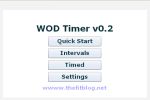
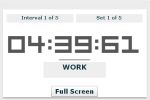
I spent a bit more time on WOD Timer and fixed some issues.
Added features include:
- Full Screen support
- Settings menu - control auto full screen and audio cues
- Audio cues now include vocal, beep and… wait for it… none.
- Added validation on the interval settings fields
Finally, I’ve also built an AIR version of WOD Timer. This version can be installed locally on you computer. Follow the instructions below.
To install locally, you will need to first install the Adobe AIR runtime. You can download and install the runtime from the Adobe Air download page:
Install Methond
- Click here to download and install Adobe AIR Runtime
- Then, click here to install WOD Timer
- When asked to save or open by your browser, just open the file
- Finally, when shown the warning, click “install” and then “continue”
As always, leave feedback in the comments section!
January 19th, 2009
WOD Timer v0.1
Interval training is huge. It’s a fantastic way to increase the efficiency of a workout and develop increased cardiorespiratory ability and work on metabolic conditioning.
Unfortunately, intervals can be somewhat difficult to time. This is especially the case when you don’t have someone dedicated to be the official “time keeper” for a workout.
In programs such as Crossfit, for example, a workout like the infamous “Fight Gone Bad” requires numerous rounds of numerous sets of intervals. Using a wrist watch or normal digital timer is not necessarily an effective way to time the workout, even when someone is the designated timer.
I figured that having some sort of automated timer would be super nice to have. So I decided to experiment a bit and came up with the WOD Timer.
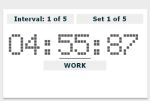
This is my first Adobe Flex app, so despite the seeming simplicity of the concept, creating this thing admittedly took a while. At the moment it’s in “beta”, but the feature list includes:
- Standard timer
- Countdown timer
- Setup and execute intervals
- Audio notifications of interval and countdown events
- Pause timer by any key press
- Simple, intuitive interface
I’m looking at future enhancements to include things like,
- Background music streaming (possible support for XSPF)
- WOD presets (for programming such as Crossfit)
- Full-screen support
Some feedback on what you would think would be good features for a WOD timer would be appreciated. Let me know in the comments!
January 11th, 2009
Lose Weight on Bananas for Breakfast… Huh? Bananas!
I have to say I’m super skeptical of this. In September 2008, there was an apparent shortage of bananas across Japan due to Japanese opera singer, Kumiko Mori, announcing on national television that she lost 15 lbs in 6 weeks by dieting as follows:
- Eat 1 or more raw bananas for breakfast, with room temperature water
- Eat whatever you want for lunch and dinner
- Dinner must be eaten by 8pm
- No dessert
- Eat until satisfied, not stuffed
- Drink only water
- An afternoon snack is fine by 3pm - chocolate or cookies is allowed (although donuts are frowned upon)
- Exercise is optional
Huh… You don’t say. Maybe the Japanese have super high metabolisms, but this is an absolutely terrible diet.
First the obvious - glad to see that donuts are frowned upon, but chocolate and cookies are not really ok mid-afternoon snacks. Then the whole banana concept. Bananas are nutritious - there’s no doubt of that as they’re loaded with vitamins and minerals. However, with an average banana containing over 27g of total carbohydrates, over 14g of sugar, and barely a notice of protein or fat, a bunch of bananas in the morning are hardly a good day starter for a weight loss diet.
The high sugar and low protein contents of the banana throw hormones around a bit, causing an insulin spike, potentially lending a hand to weight gain, rather than loss. The chocolate and donuts in the afternoon certainly don’t help and between those and the bananas, the whole diet would seem to keep insulin levels high throughout the day.
This is, of course, my opinion. I have never tried the morning banana diet and don’t intend to. However, I can’t imagine it being an effective way to lose weight.
Judge for yourself - visit the morningbanana.com to find out more.
January 10th, 2009
Mark Rippetoe on Losing 10 lbs
Super good interview on NPR with Mark Rippetoe, talking about losing some weight and tackling the New Years resolution of getting fit. Rippetoe is the author of “Starting Strength”, a phenomenon of a book in the weight lifting world, garnering praise world wide for it’s complete examination of the best way to exercise. A great quote from the interview:
“Learn how to squat. It works more muscles than any other exercise, it’s harder, it’s a longer range of motion, and it will make more difference in your appearance over a shorter period of time than any single thing you can do. You have to learn how to squat correctly. Correctly is below parallel.”
Listen to the whole thing on over at NPR: http://www.npr.org/blogs/wwrd/2009/01/what_would_rob_do_to_lose_10_p.html
Or just listen to it here:
January 8th, 2009
Cops Get Fit in The Fit Stop, Courtesy of ParticiPACTION
Found a great library of fitness related clips from the CBC radio and television archives, here. The best, by far, has to be the 1975 Cops Get Fit clip, where Constable Andy McLellan gives his boys a run through an exercise routine. Starting at 1:23 is was literally laugh out loud. View the video clip at archives.cbc.ca.
January 1st, 2009
What’s your Mix? Music to Workout To
Once in a while you will run into someone who likes to listen to talk radio or audiobooks while working out. For most of us, however, we’d prefer music. With the right mix, our intensity increases, we can push or pull more weight run harder.
What does it for each of us is different though. Personally, I like exercising to music with some hard beats and a fairly quick pace, or something that works up to a nice crescendo with lots of layers.
I’ve started putting a mix together on the music playlist creating site, imeem. Here’s my fitness mix. What’s yours?
January 1st, 2009
105 Consecutive Double Unders (Death by Double Unders)
Well, cross one goal off the list. I had originally planned to have “break 100 consecutive double unders” as one of my 2009 goals. I had decided to get on the ball and accomplish this one before the end of 2008. Since my previous PR was just over 90, this was some fairly low hanging fruit for me (I should really have made it “break 200 double unders”).
The secret of being able to work up to some high numbers when it comes to double unders is to keep the jump low - get the rope fast under you twice rather than trying to clear a fence in a tuck jump.
Another “secret” is to keep breathing. This is something that I failed to do and at around the 105 mark, I started almost blacking out. Hence the face plant at the end of the vid… doh…
December 24th, 2008
Goal Setting for 2009
Well, it seems like the year only started just yesterday, but time flies and 2008 is drawing to a close.
Was it a good year? Despite lackluster economic times, it wasn’t all that bad.
While 2008 may not go down in the history books as mankind’s most prosperous year, it has given us all an opportunity to take a step back and reassess our priorities. What is important? What is really required for fulfillment? For some, the answer will legitimately be the fancy new car or an addition to the house. For the overwhelming majority of us, however, what we really want is to simply be happy - live a good life. And I have a feeling that in 2009, we will see a growing number of people looking for self-improvement, and seeing health and fitness as a top priority.
So what are your goals? What are the things that you would like to accomplish in the coming year? 2009 will be one of the most important years of your life - make whatever you want closer to reality.
My top 5 fitness goals for 2009 are (in no particular order):
- Get 40+ consecutive pull-ups
- Achieve a 900 Crossfit total (1RM back squat + deadlift + shoulder press)
- 30 second handstand by Summer
- 21 minute 5km run by end of Summer
- Enter 10km race - break 45 minutes
- 3 weeks straight 100% strict zone diet, adhere to a moderate paleo philosophy for the rest
- Take 2 fitness courses by September
- Attend more yoga classes - increase flexibility - be able to put palms on floor with legs straight by November
- 3 reps bodyweight overhead squat by end of Summer - work on 1RM clean\jerks
- 15 consecutive ring muscle-ups by December
Goals shouldn’t be easy, but they should be achievable. Keep that in mind when you’re thinking about your own. Unachievable goals set you up for failure which leads to discouragement, frustration and loss of motivation. Set timelines for your goals and think about what actions are necessary to reach them.
Goal setting should be something that we all do - and not just for fitness and health. Educational, financial, social and family goals are also extremely important. There Are few things better than goal achievement for yielding positive change in our lives and providing motivation to continue the positive trends. Set some goals; strive for them; check them off one by one. Make 2009 your greatest year yet.
December 21st, 2008
How to do a Muscle-Up on the Rings
The Muscle-Up. It may be a beginner level skill for a gymnast, but for the vast majority of us, it is tough. Some of us have the nack and get it almost immediately while others take forever and may not ever even see one.
Of course, most who do eventually manage a muscle-up do so after numerous (or hundreds of) failure attempts. Like virtually everything, it’s practice that ultimately determines your muscle-up ability. However, what I’d like to share with you in this post are 3 tips to the Muscle-Up that will help you get there. They certainly helped me immensely.
Pre-Tip Tip - Prerequisites. Unfortunately, despite the fact that a muscle-up has a huge technique component to it, you will not be able to attain one without first being comfortable with the ring dip or ring pull-up. If you can knock out a bunch of consecutive ring dips, then you should be able to get a muscle-up.
- Tip 1 - The False Grip. This is huge. Without the false grip, I guarantee you that you will never be able to do a muscle-up on the rings. Bar muscle-ups don’t necessarily require a false grip, but ring muscle-ups definitely do (except for the elite few).The false grip essentially preps you for your support position at the apex of your muscle-up (the up position of a dip). Think about how your hand would rest on the ring in a dip. The ring lies under the palm of your hand, from the inner palm opposite the thumb to the “ball” of your index finger. Grasp the ring in this way, such that the ring is diagonal across your hand.
- Tip 2 - The Pull. Many people starting out with the muscle-up falter at this step. Your initial pull should be hard to the chest. Kip into it to help get the hard pull and pull right down to your sternum, or thereabouts. The hard pull will get you setup for the transition to the dip portion.
- Tip 3 - The Transition. Once you’ve got yourself up as much as possible, you need to transition from the pull portion to the dip. Push your head forward and turn your wrists so that your knuckles are facing out. You will likely also find it more natural and easier to do this if you also kick out your feet a bit at the same time. Bringing your fee up changes the balance of weight to your front and assists in the forward lean. Once your head is through, start the push. And push hard.
So there you have it - Three not-so-secret tips for getting your first muscle-up. Good luck!
December 21st, 2008
Lance Armstrong - Men’s Health Guy Jan 2009
So Lance makes the cover of the Jan\Feb 2009 issue of Men’s Health. As one of the planet’s most competitive guys and in obviously good shape, he’s on track to compete in the 2009 Tour de France and attempt to claim an 8th win.
How does Lance do it? How does he seemingly drive so hard and not feel any pain? According to the article on the cycling machine, he uses a training method in which he rides at an intensity just under his lactic threshold (where the move from aerobic to anaerobic takes place and the breakdown of glucose causes lactic acid build up - that good old burn).
The article didn’t go any further into his training methods, but there were some good snapshots of Lance on and a bosu. pfft… And yes, apparently Lance swings the kettlebell.
Read the Men’s Health article, here.
December 15th, 2008
Tabata Intervals
The blood was pumping fast. My quads were about to burst. The lactic acid was overflowing as though it was about to start seeping out of the pores of my legs. Just 5 more seconds in this last set and I was done… possibly for good. Who would have thought that 12 minutes of work\rest intervals would lay me out like the way it did. I mean… Just 12 minutes?
That was my first Tabata based workout - a Crossfit oldie but goodie. 20 seconds of max possible air squats, 20 seconds of pushups and 20 seconds of box jumps, each followed by 10 seconds of rest, and repeat - 8 times. And the only thing I thought afterward was, “This is supposed to be good for me, isn’t it?” Can a 12 minute workout really be doing any good? And what does Tabata mean anyway?! So I set off on a quest to find out.
Unfortunately, figuring it all out means getting into the biochemical nitty gritty of things because at the end of the day, it’s all about the ATP. ATP (or Adenosine triphosphate) is a molecule used by our cells for energy. When muscles contract, they use a significant amount of ATP. In order to produce ATP (in an aerobic capacity), our cells oxydise glucose which means that in order for us to move we require a good amount of oxygen. The O2 goes in through our mouth, to our lungs, into our blood, to the muscles that are moving where it oxydises glucose to create ATP, creating CO2 as a by-product that goes back into our blood, back to the lungs and back out through our mouths. And this is why we start breathing heavily when we workout.
For the most part, our aerobic system does all this for us - keeps our muscles energized. However, when we want to use our muscles maximally, we are limited by the aerobic system. We, as human beings, can only take in so much O2 and our cardiovascular system can only move the O2 around so quickly. The state at which we are supplying oxygen to our muscles at the highest rate our bodies can handle is called our VO2 Max. While our muscles can typically operate at levels requiring a substantialy larger amount of oxygen, our VO2 max just can’t supply it all for us. So when we’re lifting really heavy or doing a high volume of highly muscular work, our aerobic system is unable to support the effort and our bodies turn to our anaerobic system for further energy requirements for our muscles.
The anaerobic system creates the additional ATP by way of glycolysis or oxidative phosphorylation - two ATP synthesis methods that require energy packets pre-stored in our muscles. Unfortunately these energy packets are in limited supply which means that we typically have a maximum of around 2 minutes of maximal work during which time lactic acid builds up and causes that good ol’ burning muscle sensation. After anaerobic energy is depleted, fatigue will set in and max work is no longer possible. Any work from here on out will likely be mostly of the aerobic kind.
Ok - have I lost you yet? What it boils down to is that our bodies are only so efficient at using oxygen for muscular energy and we can therefore only keep up at a high intensity for a relatively short duration. If it weren’t for this constraint, we could run a 5k at 100m sprint speeds. But while we will likely never be able to run a 5k that fast, we are fortunatly able to increase our cardiovascular and oxidation efficiency through regular bouts of high intensity interval training (HIIT). By practicing workouts consisting of intervals of high intensity followed by rest periods, it has been shown that we can increase the ability of our cardiovascular system to transport oxygen to our muscles and increase the ability of our muscular cells to use the oxygen for ATP synthesis. In short, HIIT training can help us attain better endurance.
So this is where Tabata comes in. Tabata is actually the name of the Dr. who first described the 20 seconds of maximal work followed by 10 seconds of rest. Dr. Izumi Tabata of the Department of Physiology and Biomechanics at the National Institute of Fitness and Sport in Kanoya City in Japan conducted a study in 1997 to look for an ideal ratio of work to rest for interval training in order to keep someone in a VO2 max state, maximally stressing both the anaerobic and aerobic systems throughout the entire workout. He found that the ratio of 2:1 was best and described the multiple sets of 20 seconds on, 10 off methodology as being most efficient.
So there you have it. Tabata is the name of a guy who took interval training to the next level by suggesting the most efficient way to do HIIT and train one’s endurance levels. And with that, it makes sense why we should subject ourselves to the hellish HIIT workout every now and then. The Tabata is a short, intense workout that can have a significant impact on one’s overall fitness level.
December 14th, 2008
Charles Poliquin’s Take on Crossfit
In the December “Question of Strength” article on T-Nation, Charles Polquin discusses his view of Crossfit. He gives 6 reasons why he “can’t recommend CrossFit training, especially for those seeking the highest levels of athletic performance”.
Polquin is a World respected Canadian strength training coach who has trained and/or consulted numerous world class athletes and professional sports teams. His views of Crossfit are well stated in this article, but unfortunately his criticisms are nothing new and have been disputed many times in the past.
One of Polquin’s main arguments is that Crossfit utilizes high rep workouts with Olympic lifts which means that form and technique are lost and that oly lifts are best suited to low rep sets where explosive powere can be maximized. He says,
[high reps and short rest intervals shouldn't be used] with Olympic lifts, where it’s difficult to maintain proper technique with high reps. And it’s especially difficult when supersetting Olympic lifts with deadlifts, or any other multijoint exercise. If you want confirmation, just watch CrossFit trainees do these lifts in videos on their website.
The Olympic lifts should be used to develop power. If you want to develop muscular endurance, you should use simpler movements.
He makes good points and doesn’t lie, but unfortunately misses the point somewhat with what Crossfit is all about. Crossfit utilizes the oly lifts because they produce the most power (distance*force over time). There are simply no other exercises that produce the same amount of power that a clean and jerk or snatch does in a single rep. Strung in sequence and with speed, these workouts generate enormous power which is key to Crossfit’s success.
The other point that Polquin misses is that Crossfit isn’t meant to be “muscular endurance” training nor is it meant to replace an athletes periodized program. Crossfit is meant to increase fitness in a broad and multi-domained approach - as much as possible. The goal of a crossfitter is to be inclined to no athletic specificity, but to be functionally good across the board.
Read Charles Polquin’s take on Crossfit on T-Nation, here.
Read some Crossfitters’ responses to this and Polquin’s previous comments on Crossfit, here in the Crossfit forum.