June 18th, 2010
Lean Bodies Facebook Group!
Just created a Facebook group, called Lean Bodies. Definitely come join the discussion if you’re interested in fitness, health bodybuilding and nutrition! Lean Bodies Facebook Group.
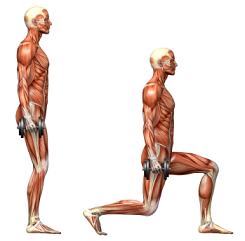 The lunge. I can’t emphasize enough how amazing this simple exercise is. One of the most difficult workouts that I have ever done (barely at that) was 400 meters of lunges. Just body weight. For my leg size, that equates to about 400 lunges. It seems like a lot, no doubt, but I had no idea how painful it would end up being. After the workout, I tried to run back to the starting point and I must have looked like a baby calf that just learned how to walk. I certainly felt like one. For days after the workout, I could barely climb a set of stairs and I was constantly limping. In fact, 400 meters of lunges is absolutely overkill. But I wanted to give you an idea of how killer lunges can be at working the big leg muscles - namely the quads and hamstrings.
To perform a good lunge, step out with one foot, then bend both knees until the back knee kisses the ground. Don’t bang your knee on the ground! Just lightly touch the ground, or hover an inch or so above if you’re worried about your knee hitting the ground. From this “lunge” position, stand back up and bring your back leg in line with your front. Done. It really is as simple as it sounds. But what you can get out of this exercise is a serious quadraceps muscle workout.
As I’ve mentioned before, working large muscles such as the quad is very good for bring up the metabolic rate during the exercise and well into the post exercise phase.
So boost your metabolism and try the following for a great workout for weight loss and metabolic conditioning:
Trust me - this workout will make your legs burn and your heart race. As simple as it sounds, it really is quite effective.
Box jumps - one heck of a plyometric exercise that can be added into virtually any circuit or interval workout. However, technique plays a huge role in affecting the level of effectiveness of this wonderful (and wonderfully simple) exercise.
Many people who do box jumps cheat a little bit. One of the fundamental components of the box jump is the hip extension and here’s where the cheaters cut the corner.
Take a look at the following sequence:
If you notice, the person doing the box jump doesn’t do a full hip extension when he lands on the box. A full extension can be reached either through completely standing up (hips over feet) at the top of the box or through a powerful leg/hip explosion off the box that causes the legs and hips to straighten out and extend.
To illustrate, take a look at another sequence:
The full hip extension is one of the most powerful movements that the human body is capable of. Many compound movements, such as the squat, deadlift, clean, or simply standing up or moving into a sprint from the starters position - all are based on the hip extension. As such, it is important to complete a box jump with a full hip extension and work those muscles to the max. Doing so will work the quads, hamstrings and glutes all that much more while increasing the energy requirements of the movement and causing increased cardiovascular stress.
Crossfit popularity has exploded over the last year. Dozens of affiliates seem to be opening on a monthly basis and the community is expanding faster than a sub 2 minute Fran. But it’s no surprise - Crossfit runs under an “open source” mantra and provides a seriously massive wealth of information. Every day, along with a new WOD (or workout of the day), some sort of video is also provided, usually detailing specifics of various movements or exercises. Dig beyond the daily WODs and into the message boards and find more exercise and nutrition information directly from the community of trainers and subject matter experts.
Additionally, Crossfit offers a subscription based membership to access their archive of journals. For a mere $25 yearly fee, you have access to all the back issues and all new articles and videos, in their entirety. The information in the journals is extremely rich and often worthy of scientific publication.
Even if you’re not interested in Crossfit or have issues with the program, the content of the Crossfit.com website is truly unmatched and is definitely a place to frequent on a regular basis.
Forget what the target and synergist muscles are in a squat? Need a target weight calculator or need to learn about fitness assessments? What about a sample cycling mesocycle or information on glycogen? Fortunately there exists a comprehensive exercise and nutrition website to help answer these questions - Exrx.net. Exrx, of course, stands for “exercise prescription” and the site clearly is capable of offering one.
Exrx.net is absolutely packed with information about exercises, anatomy, nutrition, supplements, tools and calculators, and the list goes on and on… A most useful part of the website is the weight training section, which covers the anatomical and kinetic elements of practically every exercise out there and variations thereof.
While the site is maybe low on the glitz and glam side of things, it’s truly an indispensable resource, especially for trainers or other fitness professionals.
If one of your goals with regards to fitness is body composition changes, then bodybuilding.com may be an invaluable resource for you. The site features loads of diet and muscle building information. At first glance, it’s easy to pick off bodybuilding.com as a site for meatheads, but the underlying content in the “Super Site” area is incredibly comprehensive and full of great info.
Bodybuilding.com also offers a very popular social networking sub-site, called BodySpace. With over 280,000 members (at the time of this writing), BodySpace dominates other sites that offer similar material and networking features.
For determining how many grams of protein and carbs are in a particular food item, or trying to analyze a recipe for the number of calories, there really isn’t a better (or easier) way than using NutritionData.com.
Fitness really begins to meet social networking on SparkPeople.com. Sure, there are other sites that offer similar features, but SparkPeople is 100% free and has a significantly larger membership than most of the others.
SparkPeople features nutrition, fitness and goal tracking abilities as well as a massive library of fitness and nutrition information.
I have yet to find another resource online that is as complete as TricksTutorials.com for flexibility training. Launched by Jon Call in 2002, TricksTutorials was built to showcase and provide lessons for individuals interested in the art of “tricking” - a sport consisting primarily of acrobatics (think back tucks and spinning roundhouses).
A large portion of the site is devoted to Flexibility. In this portion of the site, Jon lays out foundational information and training methods for increasing flexibility - an often overlooked part of a well rounded fitness program. He includes information on both dynamic and static stretching for practically every muscle out there. Definitely a great resource to bookmark.
Founded by Ross Enamait, RossTraining.com is dedicated to innovations in high performance conditioning and functional strength training. The website contains loads of bodyweight movements and exercises, designed to help athletes or individuals in whatever they do.
Ross has collected numerous articles and video clips over the years and has made them available on his site. He also regularly contributes to his blog, discussing various aspects of fitness and athletics.
Machines should be used by beginners and Women should not lift weights - two huge myths that Mistress Krista beats to a pulp as she discusses how lifting weights are so extremely beneficial to all and should not be feared.
The blog posts on Stumptuous.com are top notch and filled with fantastic information. Although the site is great for both sexes, many of the articles on Stumptuous.com are geared towards women and exercise. From working out while pregnant to the “truth about breasts and exercise”, if you’re a woman and looking to lift some weight, Stumptuous.com is a great resource.
Predominatly showcasing videos of huge lifts or crazy exercises and feats of strength, there is likely no other Fitness related blog on the interweb with more articles posted per day than on Straight to the Bar. But among all the freakish strength, Straight to the Bar also features some great articles.
Think “Fitness YouTube”. StrengthMill.com provides a huge library of fitness related videos. If you’re a personal trainer looking to mix things up for a client or you’re interested in finding a new exercise to try out to change things up for yourself, you’re likely to find something here.
There’s a reason why Crossfit appears numerous times on this list. It’s efficient, it works, and so many people just can’t get enough of it. However, for every one person who works the WOD daily, there’s at least one more who would like to get into Crossfit, but is hesitant to jump right in full bore. Enter Crossfit Brand X.
Crossfit Brand X was a streetfighting school, turned krav maga school, turned Crossfit affiliate. Somehow, along the way, they also adopted a forum on their website where they religiously began posting scaled Crossfit workouts.
In the Crossfit WOD section of the forum, a member (usually Garddawd) posts several versions of the main Crossfit.com website workout, each with less weight, less distance and less required fitness. This is done to help introduce new Crossfitters to the game, or to simply allow a greater range of people to take part in the workout. This, of course, attracts a large group of people and as such, gives rise to loads of other posts asking questions or showcasing some new skills.
It’s hard to look past the giant muscle-heads and bikini clad fitness models on T-Nation (Testosterone Nation), but it has become a very popular bodybuilding website and deservedly so. While it’s hard to scroll down on any page on the site without seeing something PG and NSFW, the site does have its share of good tips and articles.
Important to note, many of the writers on T-Nation are particularly critical of some methods of training like Crossfit. However, one should make sure to get a balance of all sides of the fitness World and T-Nation manages to fit in well there.
Diet, supplements, strength training, body transformation - it’s all there… and then some.
When first visiting DragonDoor.com, it’s obvious that they love the kettlebell. In fact, DragonDoor sponsors kettlebell certifications. But there’s no crime in that. Kettlebells have become super hot in the last year or so as they provide an endless amount of exercises and movements and have helped so many people acquire strength, rehabilitate injuries and lose weight.
Beyond the kettlebell action of DragonDoor.com, you’ll also find a large number of articles about body weight training, conditioning and martial arts.
Last, but not least, is ShapeFit.com. I first came across ShapeFit.com several years ago. Since then, the site has accumulated a wealth of articles about all areas of health and fitness.
Of the more interesting and useful parts of the site are the forum and social networking area. Within these pages you can find virtually any fitness or exercise information you’re looking for.
Well, it seems like the year only started just yesterday, but time flies and 2008 is drawing to a close.
Was it a good year? Despite lackluster economic times, it wasn’t all that bad.
While 2008 may not go down in the history books as mankind’s most prosperous year, it has given us all an opportunity to take a step back and reassess our priorities. What is important? What is really required for fulfillment? For some, the answer will legitimately be the fancy new car or an addition to the house. For the overwhelming majority of us, however, what we really want is to simply be happy - live a good life. And I have a feeling that in 2009, we will see a growing number of people looking for self-improvement, and seeing health and fitness as a top priority.
So what are your goals? What are the things that you would like to accomplish in the coming year? 2009 will be one of the most important years of your life - make whatever you want closer to reality.
My top 5 fitness goals for 2009 are (in no particular order):
Goals shouldn’t be easy, but they should be achievable. Keep that in mind when you’re thinking about your own. Unachievable goals set you up for failure which leads to discouragement, frustration and loss of motivation. Set timelines for your goals and think about what actions are necessary to reach them.
Goal setting should be something that we all do - and not just for fitness and health. Educational, financial, social and family goals are also extremely important. There Are few things better than goal achievement for yielding positive change in our lives and providing motivation to continue the positive trends. Set some goals; strive for them; check them off one by one. Make 2009 your greatest year yet.
Mashable’s Open Web Awards is nearing an end. The finalists were announced earlier this month and voting will continue until December 14th when the winners are crowned. Of the 25+ categories, there is a dedicated category for Sports and Fitness related sites. The 3 finalists include FitFiend and Gyminee, which are both health and fitness social networking sites. Both are also relatively new on the scene - in fact, FitFiend is still in Beta.
FitFiend describes itself as a “social network devoted to health, fitness, and athletics. It is a community that connects FitPros and FitFiends.” The site allows users to track workouts and connect with other people (be them fit pros or “fiends” - which I assume is someone totally obsessed with fitness… hrmmmm). One feature that FitFiend seems to promote, and which seems to be helping the community site, is the whole pro to client connection. It’s the Linked-In of the fitness world, perhaps moreso than the MySpace…
 Gyminee, on the other hand, seems to be a bit more mature of a website, probably due to it’s relatively longer existence. Gyminee offers much of the same as FitFiend but also includes food tracking, challenges, detailed workout programs, iPhone support and a PRO version, among other things. From a design perspective, Gyminee is stunning, in comparison to FitFiend. Again - this is likely a result of the maturity of the application.
However, the Open Web Awards are nary complete and it’s ultimately up to the community (and circle of influence that the site owners have) which site will be the victor. Regardless of which site wins, both have gained immensly from simply being finalists for the competition and their membership has likely increased as a direct result.
 The other day, I went out to crossfit class and did a typical crossfit style workout - a Tabata workout involving 8 sets of 20 seconds each of box jumps, squats and pushups, followed by 10 seconds of rest. 12 minutes of grueling intnsity. After the workout, like usual, I was laid out on the floor for a bit, wondering what the hell I was doing to myself. “This is supposed to be good for me, isn’t it?” Well, is it? We all know that crossfit is a great way to get in shape and despite sometimes almost meeting pukie, once we really get moving on the crossfit road, we all see great results. But, in all honesty, can a 12 minute workout really be doing us any good? And what does Tabata mean anyway?! I set off on a quest to find out.
Unfortunately, figuring it all out means getting into the biochemical nitty gritty of things because at the end of the day, it’s all about the ATP. ATP (or Adenosine 5-triphosphate) is a molecule used by our cells for energy. When muscles contract, they use a significant amount of ATP. In order to produce ATP, our cells oxydise glucose which means that in order for us to move we require a good amount of oxygen. The O2 goes in through our mouth, to our lungs, into our blood, to the muscles that are moving where it oxydises glucose to create ATP, creating CO2 as a by-product that goes back into our blood, back to the lungs and back out through our mouths. And this is why we start breathing heavily when we workout.
For the most part, our aerobic system does all this for us - keeps our muscles energized. However, when we want to use our muscles maximally, we are limited by the aerobic system. We, as human beings, can only take in so much O2 and our cardiovascular system can only move the O2 around so quickly. The state at which we are supplying oxygen to our muscles at the highest rate our bodies can handle is called our VO2 Max. While our muscles can typically operate at levels requiring a substantial larger amount of oxygen, our VO2 max just can’t supply it all for us. So when we’re lifting really heavy or doing a high volume of highly muscular work, we quickly deplete the energy supplied by the aerobic system and look to our anaerobic system for further energy requirements for our muscles.
The anaerobic system creates the additional ATP by way of glycolysis or oxidative phosphorylation - two ATP synthesis methods that require energy packets pre-stored in our muscles. Unfortunately these energy packets are in limited supply which means that we typically have a maximum of around 2 minutes of maximal work during which time lactic acid builds up and causes that good ol’ burning muscle sensation. After anaerobic energy is depleted, fatigue will set in and max work is no longer possible. Any work from here on out will likely be mostly of the aerobic kind.
Ok - have I lost you yet? What it boils down to is that our bodies are only so efficient at using oxygen for muscular energy and we can therefore only keep up at a high intensity for a relatively short duration. If it weren’t for this constraint, we could run a 5k at 100m sprint speeds. But while we will likely never be able to run a 5k that fast, we are fortunatly able to increase our cardiovascular and oxidation efficiency through regular bouts of high intensity interval training (HIIT). By practicing workouts consisting of intervals of high intensity followed by rest periods, it has been shown that we can increase the ability of our cardiovascular system to transport oxygen to our muscles and increase the ability of our muscular cells to use the oxygen for ATP synthesis. In short, HIIT training can help us attain better endurance.
So this is where Tabata comes in. Tabata is actually the name of the Dr. who first described the 20 seconds of maximal work followed by 10 seconds of rest. Dr. Izumi Tabata of the Department of Physiology and Biomechanics at the National Institute of Fitness and Sport in Kanoya City in Japan conducted a study in 1997 to look for an ideal ratio of work to rest for interval training in order to keep someone in a VO2 max state, maximally stressing both the anaerobic and aerobic systems throughout the entire workout. He found that the ratio of 2:1 was best and described the multiple sets of 20 seconds on, 10 off methodology. And while other ratios will strain the aerobic system, they won’t be able to top the anaerobic strain as well as 20 seconds of work followed by 10 seconds of rest.
So there you have it. Tabata is the name of a guy who took interval training to the next level by suggesting the most efficient way to do HIIT and train one’s endurance levels. And with that, it makes sense why we crossfitters are subjected to the hellish workout every now and then. The Tabata is a short, intense workout that can have a significant impact on one’s overall fitness level.
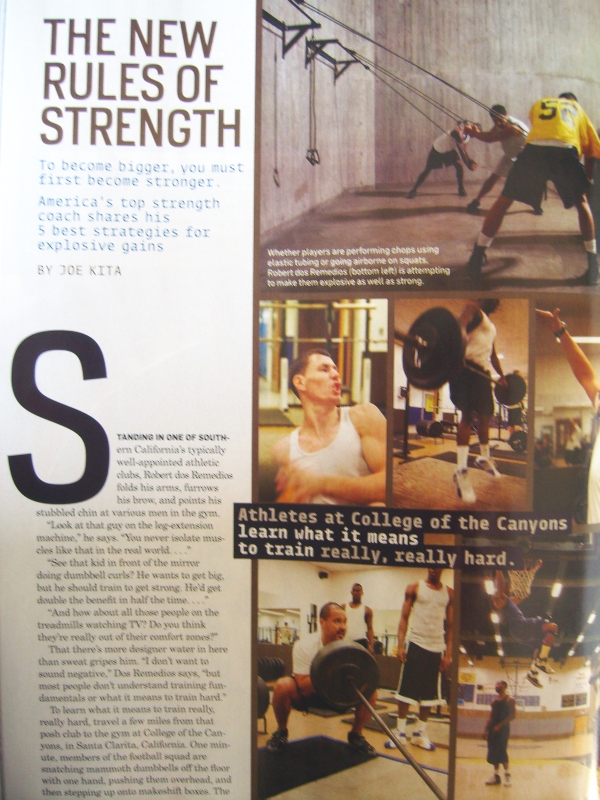
In this month’s issue of Men’s Health, Joe Kita writes a great article about the strength training approach of Coach Dos Remedios, or the College of the Canyons, Santa Clarita California and his take on getting bigger, stronger and leaner.
Coach Dos’s training consists of relatively short, high intensity compound resistance exercise, regularly changed up. By concentrating on this method of training, not only will one be able to sculpt the body they want, but they will also gain the benefits of functional fitness.
Hmm…. Where have I heard this ad nauseam before? Oh, that’s right - the tried and true crossfit. But this isn’t the first time that Men’s Health has featured an article about the benefits of athletic type strength training and how superior it is, compared to the isolation movements of the standard bodybuilding repertoire. Several months ago the Men’s Health “guy” was Jason Statham - the ripped action flic actor \ mixed martial arts practitioner who gets his physique (and uncanny strength) through high intensity functional movements. Again - crossfit-esque in every way.
So I wonder - is this the new norm? Are more and more gym rats suddenly going to be hitting the pull-up bar and working on their cleans and push jerks? Will lines begin forming for the power racks? Will squatting and deadlifts start getting the attention they deserve? Probably not. Unfortunately.
There’s no questioning Bruce Lee’s fitness level. Check out this vid of him doing some training and strutting his stuff. Two finger one armed pushups?!?
I’ve blogged about functional strength before and I took on the question of what fitness means in a previous article. Obviously, it’s quite a subjective subject - what is fitness or functional strength. For me, I like to take the approach that both fitness and functional strength are one and the same; that is, being highly physically able across a wide domain.
There’s a great article by Tyler Hass here about functional strength and it takes a similar approach to defining functional strength. A quick quote from the article about training:
“Look at Olympic lifters; these athletes are some of the strongest men in the world, with extremely high degrees of flexibility as well. My ideas on the nature of functional training are very different from the popular opinion. I prefer the Swiss Army knife approach to training. In my view, a person who trains outside of the box will be far more versatile than a person who trains in patterns and performs best inside of an artificial framework.”
I recently had to make a 3 day trip down to Sunnyvale California for work. It was a pretty good trip, as far as business goes (although the weather was oddly cooler than here at home in Canada).
Heading out of town for any length of time breaks up the normal routine. Sleeping, eating and exercising are all completely disturbed by meetings, work and jet lag. But with some effort, the potential damage to these three essential pieces of the fitness pie can minimized.
As I’ve mentioned in many previous posts, sleep is very important, not only for staying healthy and keeping your brain active, but for building muscle and weight loss.
Flying outside of your timezone will modify your sleep cycles enough to totally cause a run down. I find that flying East and gaining time is the most difficult. Regardless, catching some Z’s on the plane will help. Especially if you’re flying an all nighter. But there’s nothing worse than trying to sleep on the plane.
Bring on the plane:
as soon as the first meal and movie is finished, plug your ears, support your neck, blind yourself and wrap up in a blanket. This will help get some necessary shut eye.
When you get to your hotel and your first night arrives, try to push yourself through to your normal sleep time. Otherwise, you might find yourself going to bed super early and waking up at 4am.
When it comes to eating while away, restaurants and fast food are unfortunately on the meal plan. But even when faced with double cheeseburgers and heaping piles of mashed potatoes, there are always ways of maintaining a healthy diet.
Always try to keep the Zone mentality in mind when getting a meal. Make sure to balance the protein to carb ratio, 30:40.
If you’re getting breakfast in the hotel restaurant, bacon, eggs and some fresh fruit would be ideal. Hold off on the potatoes and toast. Lunch or dinner requires something quick? Go ahead and burger it up, but skip the fries and toss the top of the bun. If a salad is offered as a side, always go that route instead of something fried.
Dinner portions at restaurants are generally huge (especially when paid for by the company) so know your limit. Just because there’s food on the plate doesn’t mean you need to eat it all. Try to skip out on the alcohol. It may be difficult, but at least stay away from the beer. Beer may taste great but we all know what it means to the bellies.
Working out, on the other hand, may be easier to accomplish during a business trip than while at home. The distractions of family life are not present and most hotels have at least some form of exercise room available.
Check when you arrive to see what time the hotel gym opens at. If you’re flying from New York to Santa Clara, you will probably be up before the sun rises so take advantage of the early morning and charge yourself up with a workout.
Most likely, however, the hotel’s exercise room will contain mostly treadmills and possibly one or two universal machines. You’ll be lucky if there are dumbbells or any other equipment. Make the most of what is available and improvise. Remember that no matter what kind of lack of equipment you’re faced with, you will always have pushups, situps, leg raises, squats and dips.
While away on business, you will be faced with all sorts of obstacles to your normal routine. The key is to try and keep up with your daily activity and manage to eat healthy.
Don’t give up and pretend that you will just continue with your routine when you get back. More likely than not it won’t happen. Once you get distracted from your workout schedule and eating plan, it is really difficult to get back on top of it.
On November 10 - 11, Tampa Florida will hold the 4th annual Women’s Tri-Fit Fall Classic. The competition will include physique modeling, fitness routines and an all out obstacle course.
Earlier this year, in July, WTF held their World Challenge in Las Vegas for it’s 10th anniversary. The competition included a 10-foot wall climb and a struggle through 15 feet of cargo netting in a 160 yard obstacle course. Participants also had to perform a multitude of box jumps and bench presses in order to rise to the top of the competition. The usual physique modeling and fitness routines were also a part of the challenge.
For a better understanding of the event, check out the highlights from the 2007 Spring Classic, courtesy of trifittv.com:
For more information, point your browser to www.womenstrifitness.com.
It’s about this time of year that many of us are thinking, “whoa - where’d the Summer go?” There are only a handful of days left before September, only a few weeks left before Fall officially begins. Did we get everything in that we wanted to? Are there things that we didn’t even think about doing that, come to think of it, we should have done?
For me, I’m wondering if I actually took full advantage of the warm weather. Sure I ran a couple times per week and played beach volleyball every Thursday night, but my bicycle is still hanging in the garage and my inline skates have remained at the bottom of a container in my basement since last year. Two Summer activities that I really love to do have gone undone through all of these amazing Summer days we’ve had thus far in 2007.
But there’s still hope, right? If I schedule things properly, I can get in some good skating and biking before sweater weather comes blowing in. But what else have I failed to do this year? What other Summer activities should I try and enjoy before I have to wait until next year?
Here’s a top 10 list of Summer activities to try and get in before the Fall comes guns a blazing around the corner.
Men’s Health has a great fitness challenge in their latest issue. The challenge is also available on their website, here. Measure how many reps you can perform of single leg squats, chinups, pushups, measure your vertical jump height and how fast you can run a mile. Enter your scores in the MH Fit Calculator and get your MH fitness level evaluation. That simple.
However, although the exercises are simple, they are all very demanding. The average guy, for example, is only able to rip out a couple of single leg squats in a row. Pullups are similar, with most guys forgoing this exercise at the gym, in favour of lat pulldowns (which aren’t as effective IMHO). Pushups, on the other hand, aren’t uncommon. But while you might feel fairly comfortable with them, can you squeeze out 30 reps? How about 40 or even 50!? Vertical jump practice is something that I bet you rarely do. And while you might get in a 5k run here and there, the one mile challenge is an all-out run your fastest test of will power to hold out till the end.
It will be interesting to see the results when MH tabulate the average numbers from their readership. My suggestion is to try the challenge now and throughout the next 3 weeks, work up to some higher numbers by practicing the exercises as part of your normal routine. Instead of running the 5k as you normally do on a Saturday, do some sprints or 400m intervals. Work pullups into your warmup and try to get 30 reps, even if broken. Sub inclined bench presses for 3 sets of max reps pushups. Work on your single leg squats instead of some other leg press exercise you have in your normal getup. After 3 weeks is up, go another round with the challenge and see how well you’ve improved because if you keep at it, you will see a huge difference.