The Pull-up, the Pull-up Bar (and how to build one cheap)


There’s an old joke that goes something like this: a man walks into a bar and asks the bartender why his head hurts.  The bartender responds, well you just walked into a bar.

Ok - not a real joke - I just made that one up (as if you couldn’t tell).  But let me now segue into the premise of this post.  That is, the pull-up bar.

Next to some floor space and a barbell, in my opinion, the pull-up bar is the next most important item on any home gym builder’s shopping list.  What kind of bar to get and how much one should spend, however, is a little tricky.

Let’s first look at why a pull-up bar is so super good to have at your disposal:

  • Pull-ups are entirely functional, natural movements.  Think about it for a sec - the ability to pull is fundamental to our existence.  Our bodies were made to climb and I can guarantee you that at some point throughout your genealogical history, one of your ancestors was in a life or death situation, having to pull themselves up over a ledge or something.  Fortunately for you, they were able to do it.
  • Pull-ups work a broad range of muscle, from shoulders, traps, biceps, triceps, forearm, grip and all sorts of core.  Add kipping and intensity to your pull-ups, do more work in less time, and you’ve suddenly got a strength workout combined with a fierceness that tests both the anaerobic and aerobic systems and can leave you gasping for air.
  • A pull-up has many variations and progressions, from jumping pull-ups to L-Sit pull-ups and muscle-ups, there’s a variation that is accessible to all - even the weakest of us and the exercise can always provide additional challenges for the strong.

These were just a few of the reasons why pull-ups second to few exercises and the pull-up bar should be added to the top of your list of “to get” items for your home gym.

Now, what kind should you get?  There’s those bars that can be squeezed between a door frame and others that hang on the top of the frame.  The former is likely a waste of money and the latter is not very versatile and is likely costlier than the best pull-up bar in the biz - yes, I’m talking about a cheap, homemade pull-up bar.

When I say cheap, I’m talking about a low cost versus cheap as in my car fell apart after 3 days use cheap.

The biggest problem with many store bought pull-up bars is that you can’t kip on them.  While some of you may say, I don’t need to kip, true, you don’t - in fact, you don’t need to do anything.  But I’d have to add, if you want to get strong, you’d be far better off if you did or at least did most of the time.  I won’t get into why (beyond what I have said already), but here’s a great discussion of kipping versus not kipping.  If you don’t know what kipping is, watch this.

The next biggest problem with store bought bars is the cost.  You’re looking at at least $30 for the better of the kinds of consumer bars.  What you can build at home can cost as little as $20 and half an hour of your time.  The results, however, is a pull-up bar that can hold multiple people and allow you to kip and do clappers (if you ever could do clappers in the first place, that is).

What you need:

  • 2 exposed joists
  • 2 18 inch 2×6 boards
  • 6 carriage bolts, nuts and washers
  • a 3/4 inch pipe
  • A drill with a 3/4 inch bit

See the pic above.  Drill out 3/4 inch holes about an inch off the ends of the 18 inch 2×6’s.  Clamp them to the joists and drill out holes for the carriage bolts.  Unclamp the boards from the joists and bang each end of your pipe through the 3/4 inch holes (note that I’ve used a inch hole in my own to get the pipe through easier.  Best to get caps for the pipe though to make sure it doesn’t fall out while performing pull-ups though).  Bolt the contraption to the joists where you previously drilled.

Done.  Easy peasy… Now let’s taker ‘er for a ride…


Moving Towards Strength Training


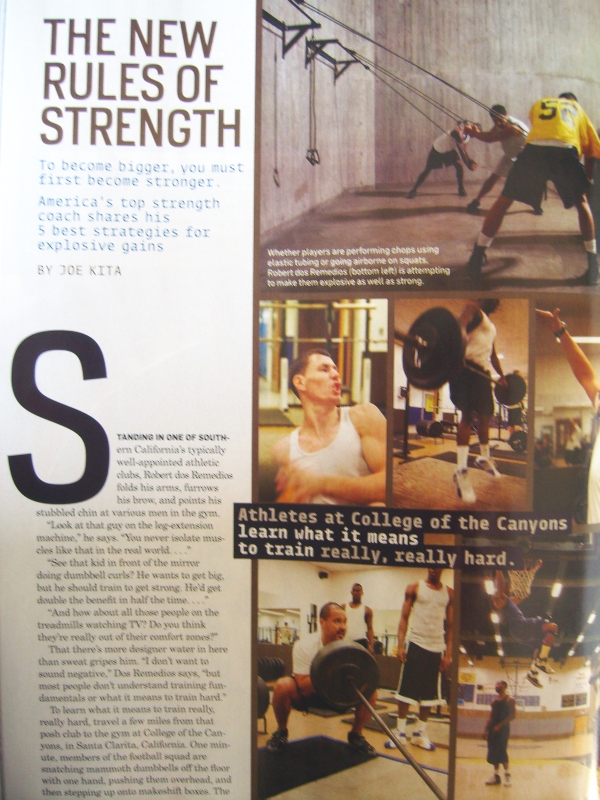
cimg3755.JPGIn this month’s issue of Men’s Health, Joe Kita writes a great article about the strength training approach of Coach Dos Remedios, or the College of the Canyons, Santa Clarita California and his take on getting bigger, stronger and leaner.

Coach Dos’s training consists of relatively short, high intensity compound resistance exercise, regularly changed up. By concentrating on this method of training, not only will one be able to sculpt the body they want, but they will also gain the benefits of functional fitness.

Hmm…. Where have I heard this ad nauseam before? Oh, that’s right - the tried and true crossfit. But this isn’t the first time that Men’s Health has featured an article about the benefits of athletic type strength training and how superior it is, compared to the isolation movements of the standard bodybuilding repertoire. Several months ago the Men’s Health “guy” was Jason Statham - the ripped action flic actor \ mixed martial arts practitioner who gets his physique (and uncanny strength) through high intensity functional movements. Again - crossfit-esque in every way.

So I wonder - is this the new norm? Are more and more gym rats suddenly going to be hitting the pull-up bar and working on their cleans and push jerks? Will lines begin forming for the power racks? Will squatting and deadlifts start getting the attention they deserve? Probably not. Unfortunately.


Killer Biceps with the Concentration Curl


Curls - one of the seemingly preferred exercises at the gym.  Pretty much at any given moment at your local gym, there’s likely at least one guy on the dumbbells, machines or barbells doing curls of one form or another.  Probably preacher curls or hammer curls with obnoxiously large amounts of weight and form that’s fit for… well… is likely terrible.

The curl is so popular because it targets one of the most sought after muscles - the biceps, or more specifically, the biceps brachii - that bulbous muscle that sits in the front of the upper arm and assists in bending the arm at the ol’ elbow.

But while curls are definitely the way to go for building the biceps, those hammer curls you’ve been doing day in and day out perhaps aren’t as effective as you’d hope. While curling one way or another isa great exercise, what you really want to do is effectively target your biceps brachii 100%- with no other muscles helping out.

Here’s where concentration curls come in.  Sitting at the edge of a bench, lean slightly forward and hold a dumbbell with one arm hanging down between your legs and your elbow against the inner thigh on the same side of your body.  Curl the dumbbell and “concentrate” on the movement - taking things slow, perhaps, but focusing on exclusively targeting the biceps.

Unlike some other curling techniques, like hammer curls, concentration curls seriously target the biceps and can help turn them into the guns you’re going for.


Maintain Your Healthy Body Weight by Breaking a Sweat


20071105.gifSeems obvious, but a recent study at Northwestern University which analyzed the BMI from over 2600 participants over the course of 20 whole years found that those who managed to get about 30 minutes of moderate to high intensity exercise per day between the age of 20 and middle age were more likely to have a healthy BMI than those who didn’t.

Although diet plays a very important part in a healthy BMI, exercise is also incredibly important. Not only is it important in keeping off body fay, exercise is a key ingredient to staying healthy all around, from maintaining strong bones and muscles as well as keeping the ticker and other organs in tip top shape.

So the moral of the post is to keep on chuggin in your workouts and activity. Get some exercise in on a daily basis, even if just some jumping jacks and air squats. Work up the heart rate and get a little sweaty. It’ll do your body good.


Small, Inexpensive yet Useful - Exercise Bands


While a barbell and some weights are all you really need to get in a good workout at home, there are other elements that can also be good for a home gym setup or to supplement your weight lifting. One great addition to your arsenal that is not only useful but is both inexpensive and extremely portable is the exercise band.

The exercise band can be purchased in a bunch of different resistances so is usable by people just getting into exercising as well as bodybuilders who have been at it for years.

For such a simple piece of equipment, the exercise band is extremely versatile. It can be used to add resistance for squats, presses and curls, just to name a few different exercises. The downside is that there is a limit to the amount of resistance available and you can’t really perform max weight lifts, nor are you really able to translate the amount of resistance from an exercise band to the amount of resistance in weights. However, for a circuit style low to high intensity workout, resistance bands can be incredibly useful.

One great resistance band exercise that I enjoy is a squat to shoulder press.  Stand on the exercise band with your feet about a shoulder’s width apart, straddling the center of the band.  Hold each handle in the respective hand.  Go down into a deep squat and then stand, imediately going into a shoulder press with the band.  That’s a single rep.  Do several sets of 10 to 20 of these as part of a circuit of either weight lifting or body weight exercises.

About.com has some more information and sample resistance band exercises here.


Thrusters


A great way to do double duty at the gym is to combine a couple of otherwise very different exercises into a single movement. Hanging leg raise to pull-up would be one example of a single gut-busting, lat-straining exercise.

Another really super great combo is the squat to shoulder press movement, otherwise known as a thruster (in crossfit lingo anyway - a key element to the “Fran” benchmark).

The thruster is, as I described, a single movement between squat and press. The exercise can really be done with any sort of weight - kettle bells, barbells, dumbbells, medicine ball - anything you can do a squat and shoulder press with.

Start with the weight positioned at shoulder level as though you are about to do a shoulder press. Instead, go down into a squat, back up and then do the shoulder press. Go immediately back to start - that’s a rep.

Try doing three sets of 8 at an empty bar, 45lbs or 65lbs to start. You may find that you can easily go up to 95 or higher (depending more or less on your shoulder press), but before you do that, attempt to increase the intensity. Whipping off 8 reps of this exercise without pausing between reps will make your heart pound and get your sweat on like you’ve just run a record mile.

P.S. Just don’t overdo it. Exercises like the thruster can really give your body a run for its money.


To Walk or To Run - Is Moderate Exercising Really Any Good?


To walk or run - a question that many people, getting into exercising ask themselves. Generally, it is well known that any kind of exercise is better than sitting on the couch, playing video games. It’s obvious. But what isn’t so obvious is whether moderate or viorous exercise is better.

In order to attempt to get the public engaged in daily activity, many governments have programs and guidelines. Unfortunately while a bit of government intervention is good, getting the proper advice is often better.

A recent study by Exeter and Brunel universities in Britan found that 56% of men and 71% of women currently believe that moderate activity is best when it comes to staying physicaly healthy. Activities such as walking have become the cup du jour for many Britains. This is likely due to the British government’s promotion of 30 minutes of moderate exercise five times a week which includes activities such as housework and gardening.

Unfortunately, moderate levels of activity only work moderately well. Dr. Gary O’Donovan, the study’s main author says that

“time and time again, the largest and most robust studies have shown that vigorously active individuals live longer and enjoy a better quality of life than moderately active individuals and couch potatoes.”

Brisk walking is definitely a popular activity these days. Whenever driving somewhere in town, I never fail to count at least a couple of people walking, spandex on and water bottles in hand. In fact, I’ve also seen some bodybuilding websites suggest that long bouts of moderately paced walking to be good for muscle building. But to me, this is somewhat counter intuitive.

I’m of the mindset that the more physically or cardiovascularly challenging an exercise, the better it is for you. While I believe that walking is certainly better than nothing, more vigorous activity should definitely also be on the menu. Here are a couple of exercises to add to your workour regime in order to accomodate some more vigor.

  • Join a spinning class. Spinning is similar to stationary cycling but usually done in a class with a high intensity and an instructor taking you through some nice intervals. Many gyms offer spinning classes for no additional cost. The beginner classes are a great way to get a little more sweat on.
  • Running. You may hate running or have trouble doing it, but it’s probably the least expensive, most accomodating method of getting in shape. Even a moderately paced run will increase your heart rate significantly over a brisk walk. Most running stores (the Running Room, for example) will host classes for beginners to advanced runners. If running is something new to you, finding a beginner class is a fantastic way to get into it.
  • Hit the weights. While many people believe that weight training is either not a vigorous method of exercise or that it is strictly for bodybuilders, lifting weights is actually a great workout with the ability to scale intensity to all levels. Working out in a circuit, in fact, may not only be vigorous activity but may also contribute to weight loss and muscle building post-workout, while resting.
  • Body weight exercising is also an inexpensive but versatile method of getting your vigorous exercises in. Again, focus on a circuit style workout consisting of things like air squats, pushups, situps, calf raises, dips or pullups and others and you will find yourself sweating buckets and getting your heart rate up nicely.

But always remember to scale your exercising accordingly. If you’re new to vigorous exercising, maybe talk to your doctor first and possibly start off slowly at either a more moderate pace or with less weight.


Developing Flexibility


Flexibility Training

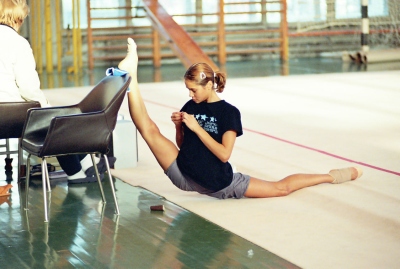
Flexibility is so important to fitness. Unfortunately not many people actually pay attention to it enough. I’m guilty as any at forgoing a daily stretch or not appropriately warming up with some stretches before a workout.

Increasing flexibility will not only help reduce injury when working out, as you get older it is important to maintain muscle suppleness in order to help avoid injury in every day activities from tying shoelaces to reaching for the seatbelt. But how does one increase their flexibility? Again, thanks to this wonderous technology called the Internet, a fantastic guide can be found here.

The tutorial is written by a guy named Jon Call, better known as Jujimufu. If you do a quick search on youtube, you will no doubt see countless videos of him. He practices tricking, or what he describes as “an aesthetic blend of flips, twists, and kicks”. It’s essentially gymnastics. His stretching tutorial is really detailed and full of great exercises.


Staying Fit While On Business Trips


I recently had to make a 3 day trip down to Sunnyvale California for work. It was a pretty good trip, as far as business goes (although the weather was oddly cooler than here at home in Canada).

Heading out of town for any length of time breaks up the normal routine. Sleeping, eating and exercising are all completely disturbed by meetings, work and jet lag. But with some effort, the potential damage to these three essential pieces of the fitness pie can minimized.

As I’ve mentioned in many previous posts, sleep is very important, not only for staying healthy and keeping your brain active, but for building muscle and weight loss.

Flying outside of your timezone will modify your sleep cycles enough to totally cause a run down. I find that flying East and gaining time is the most difficult. Regardless, catching some Z’s on the plane will help. Especially if you’re flying an all nighter. But there’s nothing worse than trying to sleep on the plane.

Bring on the plane:

  • a neck support
  • some ear plugs
  • a blind fold

as soon as the first meal and movie is finished, plug your ears, support your neck, blind yourself and wrap up in a blanket. This will help get some necessary shut eye.

When you get to your hotel and your first night arrives, try to push yourself through to your normal sleep time. Otherwise, you might find yourself going to bed super early and waking up at 4am.

When it comes to eating while away, restaurants and fast food are unfortunately on the meal plan. But even when faced with double cheeseburgers and heaping piles of mashed potatoes, there are always ways of maintaining a healthy diet.

Always try to keep the Zone mentality in mind when getting a meal. Make sure to balance the protein to carb ratio, 30:40.

If you’re getting breakfast in the hotel restaurant, bacon, eggs and some fresh fruit would be ideal. Hold off on the potatoes and toast. Lunch or dinner requires something quick? Go ahead and burger it up, but skip the fries and toss the top of the bun. If a salad is offered as a side, always go that route instead of something fried.

Dinner portions at restaurants are generally huge (especially when paid for by the company) so know your limit. Just because there’s food on the plate doesn’t mean you need to eat it all. Try to skip out on the alcohol. It may be difficult, but at least stay away from the beer. Beer may taste great but we all know what it means to the bellies.

Working out, on the other hand, may be easier to accomplish during a business trip than while at home. The distractions of family life are not present and most hotels have at least some form of exercise room available.

Check when you arrive to see what time the hotel gym opens at. If you’re flying from New York to Santa Clara, you will probably be up before the sun rises so take advantage of the early morning and charge yourself up with a workout.

Most likely, however, the hotel’s exercise room will contain mostly treadmills and possibly one or two universal machines. You’ll be lucky if there are dumbbells or any other equipment. Make the most of what is available and improvise. Remember that no matter what kind of lack of equipment you’re faced with, you will always have pushups, situps, leg raises, squats and dips.

While away on business, you will be faced with all sorts of obstacles to your normal routine. The key is to try and keep up with your daily activity and manage to eat healthy.

Don’t give up and pretend that you will just continue with your routine when you get back. More likely than not it won’t happen. Once you get distracted from your workout schedule and eating plan, it is really difficult to get back on top of it.


Great Upper Body Circuit


On Saturday, nearly two days ago, I did a great upper body circuit, from which I’m still feeling a little sore.  The great thing about circuits is the ability to expend yourself at one exercise but be able to quickly move to another exercise that targets different muscles.   The beauty being that a great workout can be completed in little time while bringing up the heart rate due to the constant movement between exercises.  In a sense, a weightlifting circuit can act as a high intensity training session while at the same time contributing to muscle growth.

In this instance, the circuit is completely upper body - primarily lats, triceps and chest - a great combo IMHO.

  • Start with a set of bench presses at about 70% effort.  Do 8 - 10 reps.
  • Move immediately to pull-ups.  If you can, do wide grip.  If you can’t, no problem.  Do what you can - jumping pull-ups, gravitron, whatever.  Do 8 - 10 reps.
  • Finally, do a set of 10 body weight dips.  After the presses and pull-ups, this will be difficult, so do what you can.  Try for another 8 - 10 reps.

Take a deep breath, rest for a couple of minutes and then hit the circuit again.  Try for 4 runs through the circuit.  You’ll feel good afterwards :)


Poll - Do You Incorporate Pull-ups in Your Workout?


As you may know from my frequent posts about them, I’m a big fan of pull-ups. I add them to every workout, as part of a warm up or as part of a simple circuit. Pull-ups work the arms like no other exercise and the multitude of variations make them a very scalable exercise.

However, I rarely see others at the gym doing them and I think its unfortunate. If you don’t already do them, I encourage you to give them a go. If you already do them in one form or another, that’s great. But I’d like to get an idea of how many people actually do pull-ups so I thought I’d create The Fit Blog’s first poll to try and get an idea.


Build a Better Back


back.jpgThe often neglected back is a very important group of muscles. It helps us in many functional movements, from pulling to lifting and supports our upper bodies all day long. Don’t neglect it any longer. Make it stronger with the following medley of exercises.

  • The barbell bent-over row. Remember to keep your back straight with this one. Otherwise, injury can result.
  • Rear pull-up. Yes, pull-ups are a great exercise for your back, specifically the lats. The rear pull-up, where your head goes under the bar is a little more difficult and requires a little more work. Perform them assisted, if necessary.
  • One arm dumbbell bent-over row. Knee on bench, bend over and pull the dumbbell up. Really attempt to flex the traps as you perform this exercise.
  • Dumbbell shrug. Again - more traps work. Shoulders go straight up and straight down. Bend over slightly and again, focus on flexing your traps as you come up.
  • Deadlift. Working the large bundle of muscles along the spine, the erector spinae, the deadlift also targets the abdominals, shoulders and leg muscles. Functionally, the deadlift movement is very important.
  • Back extensions. More erector spinae work, also targeting the lower back or waist. Don’t hyperextend too much. Like the other back work, focus on the muscles as they flex.


Quick Little Workout That Will Kick Your Butt


I usually run on Tuesday nights, but my wife decided to go to the gym so I thought I’d tag along. For some reason it was a ghost town in there. It gets like that once in a while. Some nights its packed, some nights it’s seriously empty. But I like it quiet. It gives me a chance to hog an area or machine. This is a benefit of a smaller gym when several mega gyms exist in the same city (other benefits here).

I decided on the following workout.

As many sets of the following with as little rest in between:

  • 10 kipping pullups
  • 15 pushups

I managed to squeeze out 8 sets in about 15 minutes. My arms are a little sore and the calluses on my hands look terrible. But it was good. Not only does a workout like this help build muscle, but doing max sets with as little rest as possible also gets the heart rate up.


The Benefits of Resistance Exercise for Breast Cancer Patients


It seems that there is no end to the benefits of exercising. A recent study conducted at the University of Alberta shows some benefits of resistance training for early-stage breast cancer patients undergoing chemotherapy.

The study, authored by Kerry Courneya, showed that resistance and aerobic training helped improve the self-esteem, muscular strength and lean body mass of individuals dealing with the “unfavorable changes” as a result of chemotherapy. Chemotherpy has a multitude of side effects that are generally related to these physical and mental areas. The study also found that resistance training improved the chemotherapy completion rate versus the sampled patients who were not doing any exercise.

Among women worldwide, breast cancer is the most common cancer and most common cause of cancer death. In 2007 it is expected to cause almost 50,000 deaths in the U.S. For us Canuks, we can help contribute to the possibility of a future without breast cancer by taking part in the CIBC Run for the Cure on September 30. The event will take place in 53 communities across Canada, and together we will be raising millions of dollars to help fund breast cancer research and awareness programs.

I’ll personally be running the 5k. However, 1km runs are also available in some communities for beginner runners and individuals who would be walking or are otherwise unable to complete a full run. For people who will be unable to attend a run, donations can be made at the CIBC Run for the Cure website.