Crossfit popularity has exploded over the last year. Dozens of affiliates seem to be opening on a monthly basis and the community is expanding faster than a sub 2 minute Fran. But it’s no surprise - Crossfit runs under an “open source” mantra and provides a seriously massive wealth of information. Every day, along with a new WOD (or workout of the day), some sort of video is also provided, usually detailing specifics of various movements or exercises. Dig beyond the daily WODs and into the message boards and find more exercise and nutrition information directly from the community of trainers and subject matter experts.
Additionally, Crossfit offers a subscription based membership to access their archive of journals. For a mere $25 yearly fee, you have access to all the back issues and all new articles and videos, in their entirety. The information in the journals is extremely rich and often worthy of scientific publication.
Even if you’re not interested in Crossfit or have issues with the program, the content of the Crossfit.com website is truly unmatched and is definitely a place to frequent on a regular basis.
Forget what the target and synergist muscles are in a squat? Need a target weight calculator or need to learn about fitness assessments? What about a sample cycling mesocycle or information on glycogen? Fortunately there exists a comprehensive exercise and nutrition website to help answer these questions - Exrx.net. Exrx, of course, stands for “exercise prescription” and the site clearly is capable of offering one.
Exrx.net is absolutely packed with information about exercises, anatomy, nutrition, supplements, tools and calculators, and the list goes on and on… A most useful part of the website is the weight training section, which covers the anatomical and kinetic elements of practically every exercise out there and variations thereof.
While the site is maybe low on the glitz and glam side of things, it’s truly an indispensable resource, especially for trainers or other fitness professionals.
If one of your goals with regards to fitness is body composition changes, then bodybuilding.com may be an invaluable resource for you. The site features loads of diet and muscle building information. At first glance, it’s easy to pick off bodybuilding.com as a site for meatheads, but the underlying content in the “Super Site” area is incredibly comprehensive and full of great info.
Bodybuilding.com also offers a very popular social networking sub-site, called BodySpace. With over 280,000 members (at the time of this writing), BodySpace dominates other sites that offer similar material and networking features.
For determining how many grams of protein and carbs are in a particular food item, or trying to analyze a recipe for the number of calories, there really isn’t a better (or easier) way than using NutritionData.com.
Fitness really begins to meet social networking on SparkPeople.com. Sure, there are other sites that offer similar features, but SparkPeople is 100% free and has a significantly larger membership than most of the others.
SparkPeople features nutrition, fitness and goal tracking abilities as well as a massive library of fitness and nutrition information.
I have yet to find another resource online that is as complete as TricksTutorials.com for flexibility training. Launched by Jon Call in 2002, TricksTutorials was built to showcase and provide lessons for individuals interested in the art of “tricking” - a sport consisting primarily of acrobatics (think back tucks and spinning roundhouses).
A large portion of the site is devoted to Flexibility. In this portion of the site, Jon lays out foundational information and training methods for increasing flexibility - an often overlooked part of a well rounded fitness program. He includes information on both dynamic and static stretching for practically every muscle out there. Definitely a great resource to bookmark.
Founded by Ross Enamait, RossTraining.com is dedicated to innovations in high performance conditioning and functional strength training. The website contains loads of bodyweight movements and exercises, designed to help athletes or individuals in whatever they do.
Ross has collected numerous articles and video clips over the years and has made them available on his site. He also regularly contributes to his blog, discussing various aspects of fitness and athletics.
Machines should be used by beginners and Women should not lift weights - two huge myths that Mistress Krista beats to a pulp as she discusses how lifting weights are so extremely beneficial to all and should not be feared.
The blog posts on Stumptuous.com are top notch and filled with fantastic information. Although the site is great for both sexes, many of the articles on Stumptuous.com are geared towards women and exercise. From working out while pregnant to the “truth about breasts and exercise”, if you’re a woman and looking to lift some weight, Stumptuous.com is a great resource.
Predominatly showcasing videos of huge lifts or crazy exercises and feats of strength, there is likely no other Fitness related blog on the interweb with more articles posted per day than on Straight to the Bar. But among all the freakish strength, Straight to the Bar also features some great articles.
Think “Fitness YouTube”. StrengthMill.com provides a huge library of fitness related videos. If you’re a personal trainer looking to mix things up for a client or you’re interested in finding a new exercise to try out to change things up for yourself, you’re likely to find something here.
There’s a reason why Crossfit appears numerous times on this list. It’s efficient, it works, and so many people just can’t get enough of it. However, for every one person who works the WOD daily, there’s at least one more who would like to get into Crossfit, but is hesitant to jump right in full bore. Enter Crossfit Brand X.
Crossfit Brand X was a streetfighting school, turned krav maga school, turned Crossfit affiliate. Somehow, along the way, they also adopted a forum on their website where they religiously began posting scaled Crossfit workouts.
In the Crossfit WOD section of the forum, a member (usually Garddawd) posts several versions of the main Crossfit.com website workout, each with less weight, less distance and less required fitness. This is done to help introduce new Crossfitters to the game, or to simply allow a greater range of people to take part in the workout. This, of course, attracts a large group of people and as such, gives rise to loads of other posts asking questions or showcasing some new skills.
It’s hard to look past the giant muscle-heads and bikini clad fitness models on T-Nation (Testosterone Nation), but it has become a very popular bodybuilding website and deservedly so. While it’s hard to scroll down on any page on the site without seeing something PG and NSFW, the site does have its share of good tips and articles.
Important to note, many of the writers on T-Nation are particularly critical of some methods of training like Crossfit. However, one should make sure to get a balance of all sides of the fitness World and T-Nation manages to fit in well there.
Diet, supplements, strength training, body transformation - it’s all there… and then some.
When first visiting DragonDoor.com, it’s obvious that they love the kettlebell. In fact, DragonDoor sponsors kettlebell certifications. But there’s no crime in that. Kettlebells have become super hot in the last year or so as they provide an endless amount of exercises and movements and have helped so many people acquire strength, rehabilitate injuries and lose weight.
Beyond the kettlebell action of DragonDoor.com, you’ll also find a large number of articles about body weight training, conditioning and martial arts.
Last, but not least, is ShapeFit.com. I first came across ShapeFit.com several years ago. Since then, the site has accumulated a wealth of articles about all areas of health and fitness.
Of the more interesting and useful parts of the site are the forum and social networking area. Within these pages you can find virtually any fitness or exercise information you’re looking for.
7 Comments | In: crossfit, exercise, exercise tools, fitness, kettle bells, nutrition | tags: fitness, fitness links, Fitness Websites, online exercise sites, online fitness, online fitness resources, top fitness sites, websites. | #

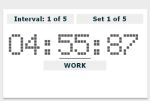
 The other day, I went out to crossfit class and did a typical crossfit style workout - a Tabata workout involving 8 sets of 20 seconds each of box jumps, squats and pushups, followed by 10 seconds of rest. 12 minutes of grueling intnsity. After the workout, like usual, I was laid out on the floor for a bit, wondering what the hell I was doing to myself. “This is supposed to be good for me, isn’t it?” Well, is it? We all know that crossfit is a great way to get in shape and despite sometimes almost meeting pukie, once we really get moving on the crossfit road, we all see great results. But, in all honesty, can a 12 minute workout really be doing us any good? And what does Tabata mean anyway?! I set off on a quest to find out.